Buying Guides
Mixed-SKU Retail Pallets: Test the Load After Every Pick
Approve plastic pallets for mixed-SKU retail loads by testing full, part-picked, and rebuilt states for support, stability, restraint, and identification.
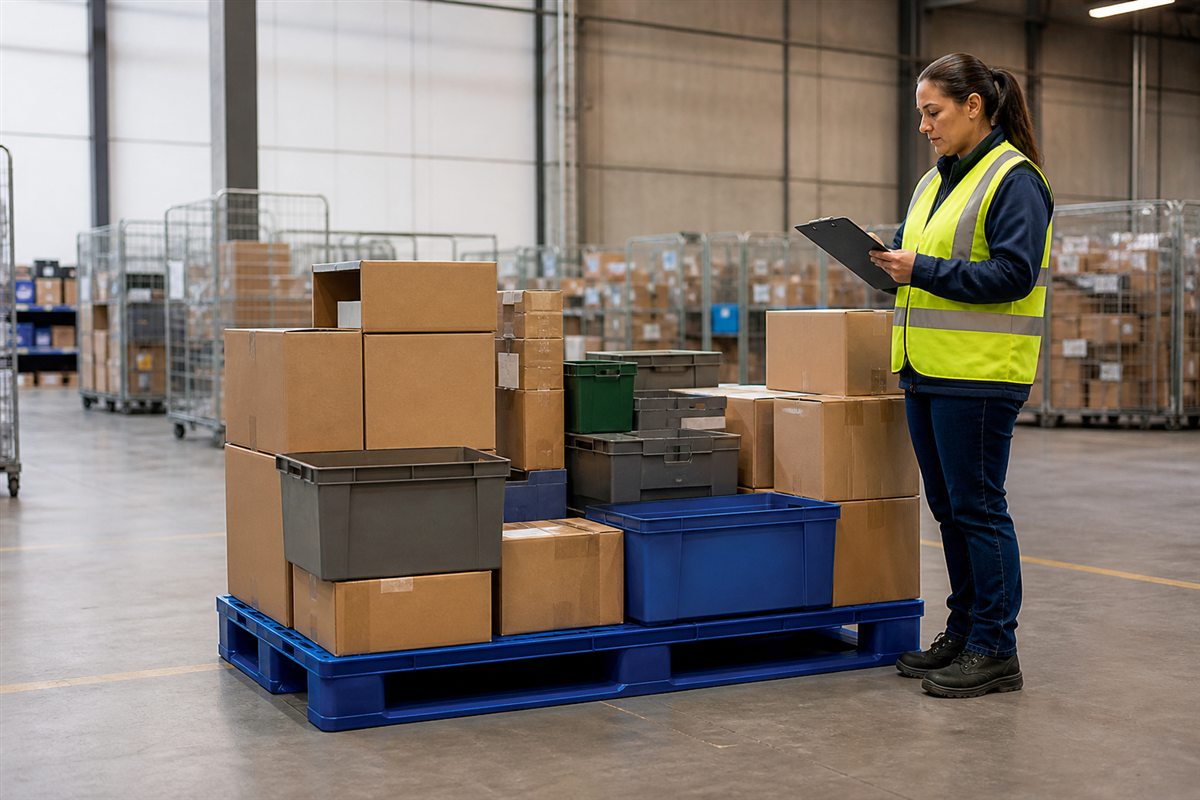
A mixed-SKU pallet can leave a build station square, wrapped, and apparently stable, then become a different handling problem after only a few picks. Removing one dense tote may shift weight toward an edge. Taking a lower carton may leave the cases above bridging a gap. Rebuilding the load may cover the logistics label or change which shipment record describes the unit.
Approve the changing load, not just the full pallet. The practical boundary is a pallet-and-process envelope: defined load states, an allowed pick sequence, restraint rules, handling limits, identification steps, and clear conditions that trigger a rebuild or hold.
Define the load states that need approval
Do not begin with every possible SKU combination. Begin with the moments when the load’s behaviour can change.
Use at least these three states in the approval plan:
- Early build or late depletion: only a small part of the deck is occupied, so a few cases or tote feet may concentrate weight and leave a narrow base.
- Full outbound state: the greatest planned height, footprint, gross mass, wrap pattern, and visibility limits are present.
- Least-stable part-picked state: the normal pick sequence has removed the cases that provided support, symmetry, or restraint.
A fourth state is needed when returns, substitutions, or replenishment can introduce damaged cartons, open totes, loose items, or a different package base.
For each state, record the SKU or package type, quantity, position, gross mass, height, deck contact, restraint, label location, and handling equipment. The aim is not to predict every order. It is to identify a bounded operating envelope and the changes that require another decision.
Separate three failure mechanisms
Mixed-load approval becomes clearer when three questions are kept separate.
Is the product supported by the pallet? Carton corners, tote feet, trays, pails, and bags may land on different parts of an open or closed deck. As items are picked, a package that was supported by its neighbour can be left bridging a deck opening. Use the site’s load-footprint approval check to inspect contact points, local deflection, overhang, and the effect of wrap tension.
Can the handling equipment control the resulting load? OSHA’s forklift load-composition guidance explains that load size, shape, position, and weight distribution affect truck capacity and stability. A gross weight below the truck’s headline capacity is not enough when an irregular load moves its centre of gravity away from the assumed load centre. Equipment approval and operating method belong with the responsible site team and the equipment manufacturer’s instructions.
Does the unit remain restrained for movement? The pallet deck cannot compensate for a weak stack, an open side, or wrap that no longer contains the reduced load. After picking, confirm whether the unit can travel as it stands, needs to be rewrapped or strapped, or must be rebuilt. For truck or container movement, connect the result to the separate load-shift prevention guide .
Keeping these mechanisms separate prevents a misleading pass. A deck may support every package while the load is still off-centre for the truck. A wrapped stack may stay together while its smallest contact points overload one deck zone.
Turn the pick sequence into a control
The hardest mixed load is not always the fullest one. It may appear halfway through the route, after the wrong support case is removed.
Run the intended pick sequence with the operations team. Note which items are removed first, whether an operator must reach across an unstable stack, and when a lower package stops supporting the items above. Then define a small number of rules that can actually be followed during a shift. Examples include keeping dense, structurally sound packages low when the order allows; avoiding a pick that leaves an unsupported bridge; and moving an unstable remainder to a rebuild point before powered travel.
The rule needs an observable trigger. “Use extra care” is not a control. “Hold when the remainder leans, crosses the pallet edge, exposes an unsupported base, loses the approved restraint, or obscures the required identifier” gives the operator a decision that can be checked.
Changes in carton strength, tote design, pick path, pallet revision, wrap program, equipment, floor route, rack use, or destination handling should trigger review. A previous pass belongs to the tested configuration, not to the phrase “mixed-SKU pallet.”
Keep the logistics record attached to the right unit
A changing physical load also changes the information that receiving and replenishment systems need.
The GS1 Logistic Label Guideline defines a logistics unit as any composition established for transport or storage that must be managed through the supply chain. It uses the Serial Shipping Container Code (SSCC) to identify that unit. For a heterogeneous logistics unit containing different trade items, the guideline does not use one contained-item GTIN as a description of the mixed contents; electronic messages linked to the SSCC carry the detailed information.
Translate that into a site trial:
- scan the unit before wrap, after wrap, after representative picks, and after any rebuild;
- check that the label stays visible and undamaged in the actual approach direction;
- confirm that the WMS or shipping record shows the current contents and status rather than the original full build only;
- define with the trading partner when a rebuilt or split load remains the same logistics unit and when a new identification event is required;
- keep the temporary logistics-unit ID separate from any permanent ID used to manage the reusable pallet asset.
GS1 supplies the identification framework; it does not decide the site’s rebuilding, SSCC reassignment, or data-correction workflow. Record that workflow before the pilot. The existing plastic pallet traceability guide covers asset IDs, scan points, and return control in more detail.
Run one trial that follows the load through change
The sample trial should reproduce a short but complete operating sequence. Agree the pass/fail criteria before the sample arrives.
| Trial point | Evidence to retain | Hold or rebuild when |
|---|---|---|
| Initial build | Package bases, positions, mass, height, deck contact, and planned restraint | A contact point misses the intended support or the build already depends on a weak package |
| Full-load movement | Fork entry, deck response, load lean, restraint, route, and scan result | The load shifts, the pallet twists, handling is obstructed, or identification cannot be read |
| Representative picks | Pick order, reach and interference observations, remaining support, and changed centre of gravity | A pick creates an unsupported bridge, an off-centre remainder, or an uncontrolled open side |
| Rebuild or re-restraint | New pattern, wrap or strap method, status update, and label association | The revised unit cannot be reproduced or its record no longer matches its contents |
| Final handoff | Receiving equipment, condition, scan result, exception owner, and acceptance decision | Destination handling or data requirements fall outside the tested envelope |
Use a normal mix and a difficult but plausible mix. Include the least-stable point in the pick path rather than inventing an extreme load that never occurs. Controlled starts, stops, turns, transfers, storage support, and destination handoff should be set by the responsible operations and safety teams.
The result should name the approved states, restrictions, owner, and retest triggers. If the sample only passes when one experienced operator improvises, the process has not passed.
Put the changing load into the RFQ
A supplier cannot evaluate “mixed retail goods” without the operating envelope. Give competing suppliers the same brief:
- pallet footprint and required entry directions;
- normal and difficult package bases, positions, gross masses, and heights;
- full, least-stable part-picked, and rebuilt load states;
- floor, rack, conveyor, pallet-truck, forklift, wrapper, vehicle, and receiving interfaces that actually apply;
- restraint method and the point at which the load is rewrapped, strapped, or rebuilt;
- label placement and scanning constraints;
- sample-trial sequence, evidence, pass/fail rules, and changes that require retesting.
Ask the supplier to tie any load or deflection statement to the exact pallet revision, support condition, load distribution, temperature, and duration. Do not transfer a rating from a uniform test load to an irregular part-picked condition without supporting evidence.
Use the plastic pallet category to compare candidate formats after the envelope is defined. For a bounded discussion, send the load states, package contact points, equipment route, restraint method, and trial criteria rather than a single maximum weight.
Approval is complete when the pallet and the operating rule pass together. The unit must remain supported, controllable, restrained, and correctly identified at the states that really occur—not only in the photograph taken before the first pick.