Industry Insights
Recycled Plastic Pallet Claims: Which Evidence Model?
Use a short evidence check to distinguish physical material proof, mass balance, and book-and-claim before accepting a recycled-plastic pallet claim.
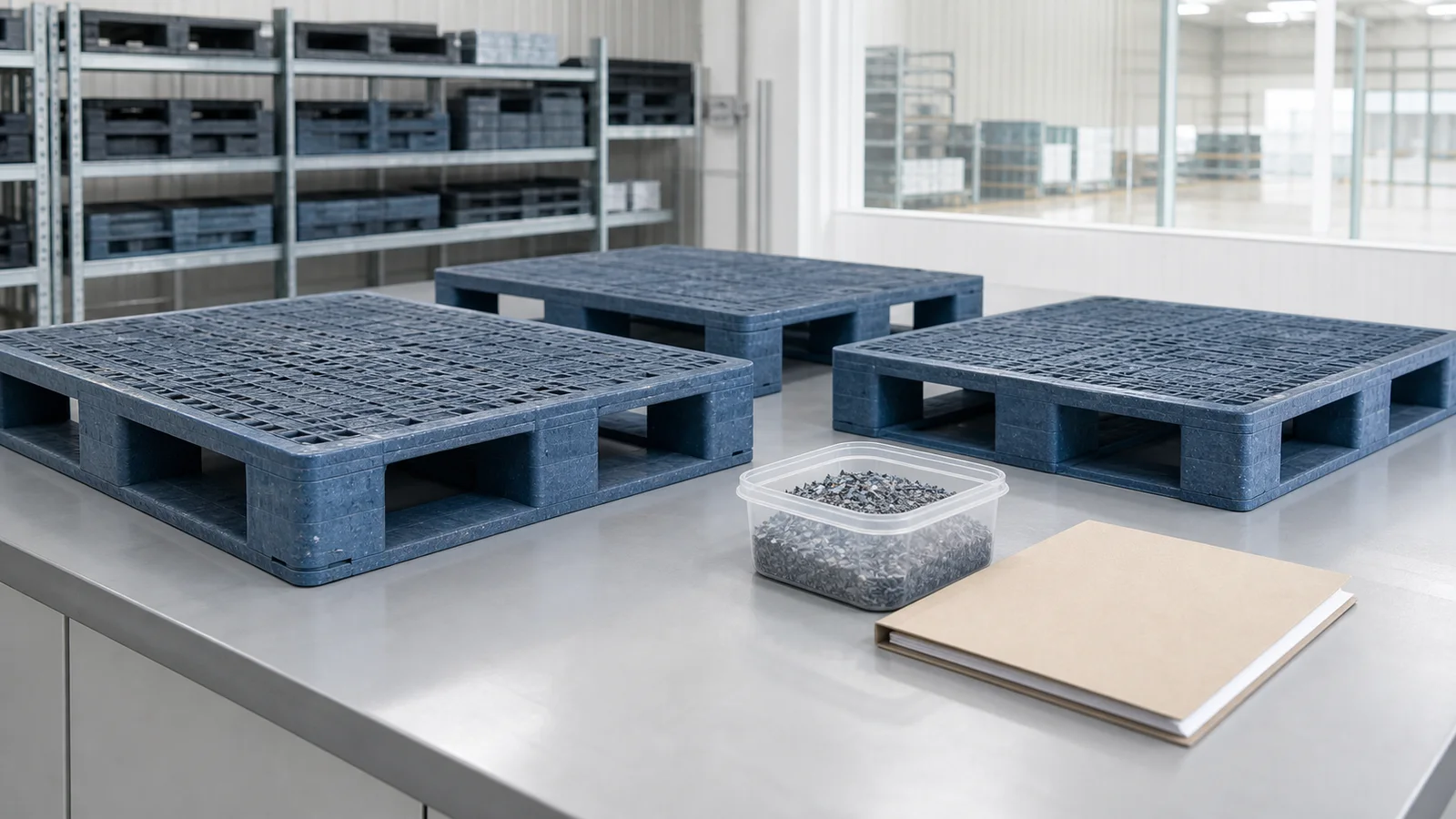
A supplier’s recycled-content statement is not complete until it says which evidence model supports it. Before accepting the statement for an RFQ, customer file, or sustainability communication, ask whether it is tied to the physical pallet, a mass-balance allocation, or a book-and-claim system. Those models can all have a legitimate role, but they answer different questions.
ISO published ISO 22095-2:2026 for mass balance and ISO 22095-3:2026 for book and claim. Both standards address system boundaries, attribution, transparency, communication, and claims; each also distinguishes its model from the other. They are cross-sector chain-of-custody references, not a pallet approval, recycled-percentage certificate, food-contact clearance, or performance test. ISO 22095-2:2026 and ISO 22095-3:2026 are the useful starting points.
Ask one question before comparing percentages
Start with this sentence in the RFQ or supplier review:
What chain-of-custody model supports this recycled-content claim, and what exactly does that model let us say about this quoted pallet and supplied lot?
The answer should name the model, the product scope, the time and geographic boundaries where relevant, the claim wording, and the document owner. A percentage alone is not that answer.
Do not collapse three different evidence routes
| Evidence route | What it can help establish | What it does not establish by itself |
|---|---|---|
| Physical material or controlled-blend evidence | A supplier may tie a stated material route, component scope, or lot to the quoted pallet where its records support that link | Load performance, food-area suitability, customer acceptance, or every external environmental claim |
| Mass balance | ISO 22095-2:2026 covers a chain-of-custody model for attributing specified characteristics to material or product flows, including system boundaries, conversion factors, and claims | That every gram of recycled input is physically present in the individual pallet delivered to the buyer |
| Book and claim | ISO 22095-3:2026 covers a model for attributing specified characteristics within a system, with its own boundaries, transparency, communication, and claim rules | Physical traceability from a recycled input to this particular pallet unless the supplier separately provides that evidence |
This is a scope check, not a ranking. Do not call one model “better” in the abstract. The useful question is whether it supports the wording and decision in front of you.
Match the claim to the buyer’s actual job
Three common jobs need different evidence.
Buying a pallet for a warehouse route. Start with pallet model, geometry, material route where disclosed, supplied-lot identity, and the real load, handling, temperature, hygiene, or automation conditions. A chain-of-custody statement does not replace the route trial or supplier limitation statement.
Reporting a recycled-content claim. Ask whether the intended wording refers to the physical product, an allocated characteristic, or a separate claim instrument. Keep the model name and boundary with the claim record. Do not turn a mass-balance or book-and-claim statement into an unqualified claim that the individual pallet contains a physical percentage unless the supplier has separately supported that wording.
Answering a customer or auditor. Send the stated claim, model, scope, boundary, period, document identifier, and responsible owner together. If any item is missing, say that the evidence is incomplete rather than filling the gap with a sales description.
A short supplier evidence check
Use these questions before releasing customer-facing wording:
- Which model supports the claim: physical or controlled blend, mass balance, or book and claim?
- Does the statement apply to this pallet model, color, component, and supplied lot, or only to a wider material or product flow?
- What wording is permitted by the system owner or supplier record? Quote it exactly.
- What are the relevant time, geographic, conversion, or allocation boundaries?
- Who can confirm the statement if the buyer, customer, regulator, or certification owner asks for the supporting record?
For a low-risk internal purchasing file, a clear supplier answer may be enough to decide whether to request more documents. For public claims, regulated markets, customer scorecards, or contractual commitments, the buyer’s sustainability, legal, quality, or customer owner should approve the final wording.
Keep material evidence separate from route approval
Chain of custody is not a substitute for the normal pallet approval file. It does not show that a plastic pallet is suitable for racking, forklifts, conveyors, washing, cold storage, food-area use, chemical exposure, ESD control, or a customer’s pool.
Keep two records:
- the claim record: model, scope, boundaries, permitted wording, document reference, and owner;
- the route record: pallet model, supplied-lot controls, load, support, equipment, environmental conditions, trial evidence, and release owner.
The existing recycled-content RFQ evidence check helps define product scope, lot evidence, and supplier change control. This page adds one narrower decision: whether the chain-of-custody model supports the wording being proposed. Use the change-control log when the model, material route, supplier, or claim wording changes after sample approval.
Release rule
Use a recycled-plastic pallet claim only when the buyer can state what is claimed, which evidence model supports it, what that model does not prove, and who owns the supporting record.
Hold the claim for clarification when the model is unnamed, the pallet scope is unclear, a physical-content statement is inferred from an allocation model, or the route approval is being assumed from material evidence. The supplier, certification-system owner, customer, and responsible local or legal owner must confirm any final external claim and any route-specific acceptance.