Industry Insights
Forklift Impact Control for Plastic Pallet Lifecycle: A Practical SOP for Warehouse Teams
Learn how B2B warehouse teams can reduce pallet cracking and unplanned replacement cost by standardizing forklift impact controls, incident coding, and lane-level operating rules.
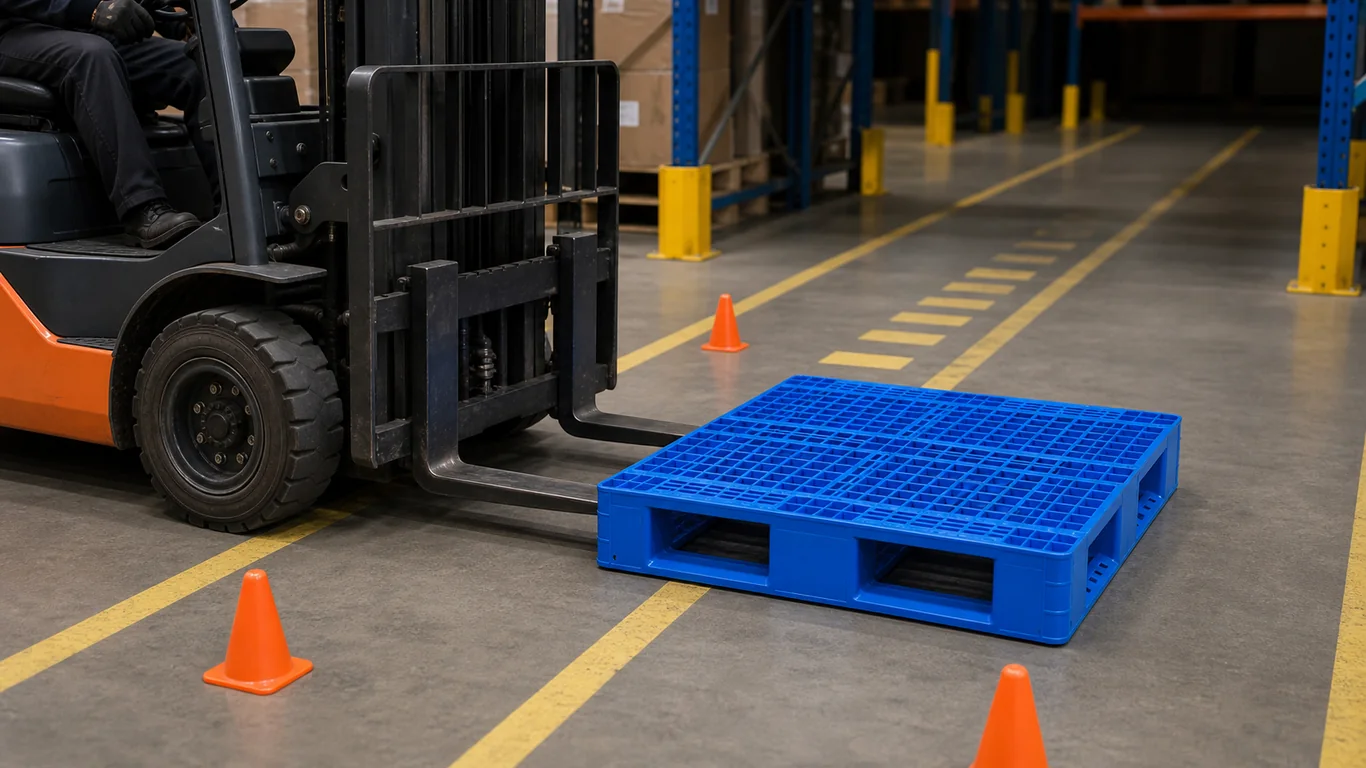
In many warehouses, plastic pallet failures are treated as a material problem first. In practice, the bigger variable is often forklift impact behavior.
Two sites can use the same pallet model, carry similar loads, and still show very different crack rates simply because entry angle, fork height discipline, and rack approach speed are managed differently.
For operations leaders, the question is straightforward:
How do you turn forklift impact from a random loss factor into a controlled operating metric?
This article gives a lane-level SOP framework you can deploy across inbound, racking, and outbound movements.
1) Why impact control matters more than many teams expect
Most pallet damage in high-throughput facilities is cumulative. A single hard hit may not cause immediate failure, but repeated micro-impacts at the same zones (fork entry lip, runner transitions, deck corners) accelerate crack initiation.
That means lifecycle cost is driven by:
- how often impact happens,
- where impact concentrates,
- and how quickly damaged units are removed from circulation.
If your site is moving to rack-capable formats such as 3-runner plastic pallets , impact discipline is especially important because preserving geometry is critical for predictable rack performance.
2) Build one common damage language before you buy more pallets
Many companies cannot improve because procurement, supervisors, and forklift operators describe damage differently.
Start with a 4-code incident taxonomy that every shift uses:
- Code A — Cosmetic: no structural influence, monitor only.
- Code B — Functional risk: local deformation, still usable in floor staging but restricted from racking.
- Code C — Structural crack: immediate removal from circulation.
- Code D — Impact event with product risk: pallet and load incident investigation required.
Then add three mandatory fields to each report:
- Lane/location;
- Handling step (pickup, turn, rack entry, unload);
- Forklift ID and shift.
Within 2–4 weeks, most teams can identify the top impact hotspots and operator behaviors driving replacement cost.
3) Set lane-level operating windows (not one warehouse-wide rule)
A single speed rule for the entire site usually fails. Define operating windows by lane type:
Rack lanes
- Lower travel speed near beam entry;
- Mandatory fork leveling before insertion;
- No corrective side-push once pallet touches beam.
For rack projects, align this SOP with your structural checks in this racking and reinforcement checklist .
Floor staging and cross-dock lanes
- Controlled turning radius at peak traffic intersections;
- Standardized approach angle to avoid corner strikes;
- Dedicated buffer zones for damaged pallet segregation.
Cold-room transitions
- Reduced speed at door thresholds;
- Additional checks for brittle-edge damage after thermal transitions;
- Shift handover note for repeated impact points.
4) Define procurement specs that support impact resilience
Impact reduction is operational, but procurement can reinforce it by tightening RFQ clauses.
Include these items in your next quotation package:
- Fork entry geometry tolerance;
- Runner edge thickness at high-contact zones;
- Reinforcement configuration and declared use limits;
- Acceptance sample criteria tied to your lane profile.
If your RFQ template is still generic, adapt this plastic pallet RFQ specification checklist and add an “impact-governance” section.
5) Train by scenario, not by policy slides
Operators already know they should “be careful.” What reduces incidents is scenario training based on actual lane conditions.
Use short drills:
- misaligned fork entry correction,
- rack approach under limited visibility,
- high-load turning at intersection points,
- damaged pallet identification and isolation.
Pair each drill with measurable pass criteria (time, alignment accuracy, contact-free completion rate).
For safety baselines, keep your local program aligned with recognized forklift requirements such as OSHA powered industrial trucks guidance and your applicable national rules.
6) KPIs that connect operations to replacement cost
Track a small dashboard weekly:
- Impact events per 1,000 pallet touches;
- Code C/D incidents by lane;
- Average days from damage detection to isolation;
- Pallet replacement rate by forklift team;
- Product-damage incidents linked to pallet instability.
These indicators should be reviewed jointly by warehouse operations, EHS/quality, and procurement.
If your site is in conversion phase, combine these KPIs with a staged rollout model like this 90-day plastic pallet pilot program .
7) 30-60-90 day rollout plan
First 30 days: visibility
- launch damage coding,
- map top 10 impact hotspots,
- isolate high-risk lanes.
Day 31-60: control
- enforce lane-specific operating windows,
- retrain high-incident teams,
- apply restricted-use tags for Code B pallets.
Day 61-90: stabilization
- update RFQ and acceptance standards,
- lock monthly KPI review cadence,
- confirm replacement-rate trend before expanding pallet volume.
Final takeaway
Plastic pallet lifecycle performance is not determined only by resin, design, or price. In busy warehouses, it is heavily shaped by how consistently forklift impact is controlled.
When teams standardize incident coding, lane rules, and procurement criteria, pallet lifespan becomes more predictable, safety risk drops, and replacement budgets become easier to manage.