Industry Insights
Plastic Pallet Sanitation SOP for Food Warehouses: How to Control Hygiene Risk Without Slowing Throughput
A practical framework for food and beverage warehouses to define pallet cleaning frequency, verification checks, and segregation rules that reduce contamination risk and protect operational efficiency.
In food and beverage warehousing, pallet decisions are often made by load capacity and price first. But once audit season starts, a different question becomes urgent:
Can your pallet flow pass hygiene verification every day, not only during inspections?
For many operations, contamination risk does not come from one dramatic failure. It comes from small routine gaps—mixed pallet usage between zones, irregular wash cycles, poor damage segregation, and weak verification records.
This article provides a practical SOP framework for one specific goal: keep plastic pallet hygiene risk under control while maintaining shift-level throughput.
1) Why pallet hygiene failures happen in otherwise well-run warehouses
Food sites often have strong sanitation programs for floors, tools, and process equipment. Pallets are harder because they move across multiple zones and teams.
Typical failure points include:
- pallets moving from dock areas to clean zones without clear status identification,
- washing based on “visible dirt” instead of risk-based frequency,
- damaged pallets returning to circulation before inspection,
- inconsistent detergent or disinfectant concentration,
- no release criteria after cleaning.
The result is predictable: sanitation effort increases, but audit confidence does not.
A practical SOP should therefore treat pallets as mobile food-contact-adjacent assets with controlled status, not as generic transport tools.
2) Build a zone-based pallet hygiene map before writing cleaning rules
A single cleaning frequency for the whole warehouse is usually ineffective. Start with zone classification and assign pallet rules by exposure risk.
Zone A: high hygiene sensitivity
Examples: finished-product buffer zones for ready-to-eat goods, open secondary packaging interfaces, and pre-shipment staging for high-risk customers.
Control approach:
- use dedicated clean-status pallets only,
- enforce documented release checks,
- prohibit direct return from receiving or outdoor docks.
Zone B: controlled logistics zones
Examples: internal transfer aisles, wrapped finished goods storage, and standard pick-and-stage areas.
Control approach:
- apply scheduled cleaning cycles,
- allow pallets only if status is valid and traceable,
- isolate damaged units immediately.
Zone C: receiving and external exposure zones
Examples: inbound docks, temporary outdoor staging, mixed supplier handling points.
Control approach:
- treat pallets as “unclean until verified,”
- require gateway checks before entering B or A zones,
- use separate storage for pre-clean and post-clean pallets.
If your warehouse also handles frozen products, integrate low-temperature handling checks with this freezer pallet specification framework so hygiene and structural controls stay aligned.
3) Define sanitation frequency by risk trigger, not by calendar only
Weekly washing schedules are easy to plan but often fail in real operations. A better method is to combine fixed cycles with trigger events.
Minimum trigger set to include in SOP:
- Zone transfer trigger: any pallet moving from C to B/A must pass cleaning and release check.
- Product trigger: direct use in allergen-sensitive or high-care product lanes.
- Event trigger: spill, leak, visible residue, pest-related observation, or return from external transport.
- Time trigger: maximum days in circulation without verified cleaning, even if no visible contamination.
This hybrid model prevents both under-cleaning and over-cleaning.
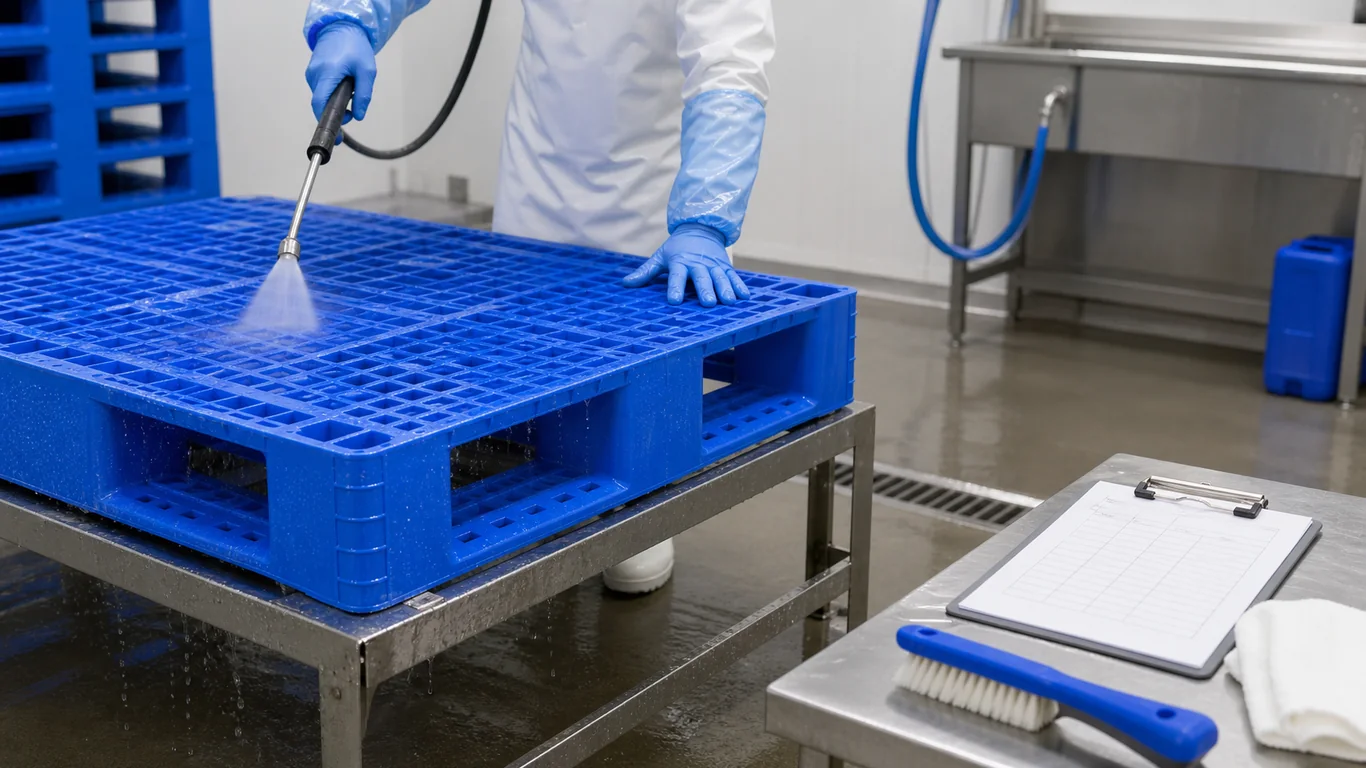
4) Standardize cleaning method parameters so results are repeatable
“Washed” is not a standard. The SOP should lock key process variables that can be trained, measured, and audited.
Define at least:
- pre-rinse requirement (yes/no and water temperature range),
- detergent type and target concentration band,
- mechanical action requirement (manual brush, pressure wash, or tunnel wash),
- contact time before rinse,
- disinfectant type and concentration range where required,
- drying or drain-down rule before release.
For food facilities, align your sanitation controls with your HACCP program and management standards such as ISO 22000 .
In U.S.-regulated operations, ensure procedures and records also support preventive-control expectations under FDA FSMA programs (FDA FSMA overview ).
5) Set release criteria: when is a cleaned pallet actually usable?
Many warehouses clean pallets correctly but release them inconsistently. Release criteria should be simple and binary.
Recommended release checklist:
- no visible residue, pooling water, or foreign material,
- no structural cracks at deck corners, fork entry lips, or runner transitions,
- status mark updated (tag, color card, barcode event, or WMS status),
- assigned to a permitted zone based on hygiene class.
Any pallet failing one item is blocked and moved to rewash or damage quarantine.
If you are defining procurement specs for hygienic lanes, include these release and damage criteria in your RFQ package using this plastic pallet RFQ checklist .
6) Choose pallet design features that reduce sanitation workload
The easiest pallet to clean is not always the lightest or cheapest. In food warehouses, design details change labor hours and verification speed.
Practical selection points:
- smoother deck and runner geometry with fewer dirt-trap recesses,
- structure suitable for your storage mode (rack, floor, or mixed),
- material consistency and traceable batch control,
- stable dimensions to avoid secondary damage during handling.
For lines requiring color segregation (for example, allergen control or zone coding), food-grade pallet options such as food series 1210 models can simplify daily visual control when combined with SOP tagging rules.
7) KPI dashboard: track sanitation performance without adding reporting burden
A pallet sanitation SOP becomes sustainable only when operations and quality teams share the same metrics.
Track a small but meaningful KPI set:
- pallet cleaning compliance rate by zone,
- release pass rate on first inspection,
- rewash rate and top three causes,
- damaged-pallet quarantine lead time,
- audit non-conformances linked to pallet status,
- labor time per 100 pallets cleaned.
Review weekly at shift-supervisor level and monthly with procurement/quality. This keeps corrective action fast and prevents “audit-only” behavior.
8) 30-day rollout plan for multi-shift warehouses
Week 1: map and classify
- finalize Zone A/B/C boundaries,
- define status labels and movement rules,
- assign ownership across warehouse, quality, and sanitation teams.
Week 2: pilot one lane
- test cleaning parameters and release checklist,
- validate labor assumptions per shift,
- adjust trigger thresholds based on real flow.
Week 3: train and standardize
- train operators and sanitation crew by scenario,
- publish one-page visual SOP at key points,
- start structured KPI capture.
Week 4: lock governance
- freeze SOP version and approval workflow,
- set audit sampling frequency,
- align replenishment and replacement rules with pallet damage data.
A controlled 30-day rollout is usually enough to move from “inconsistent cleaning activity” to “auditable hygiene control system” without disrupting outbound service levels.
Final takeaway
Food warehouse hygiene control is not only about cleaning more often. It is about controlling pallet status, movement, verification, and release as one operating system.
When sanitation SOPs are risk-based, measurable, and linked to daily flow, plastic pallets become a reliable hygiene asset rather than an audit uncertainty.