Buying Guides
Plastic Pallets for Air Freight: When Lower Tare Reduces Chargeable Weight
Calculate when a lighter plastic pallet changes air-freight chargeable weight, then compare loaded dimensions, handling fit, and carrier rules before ordering.
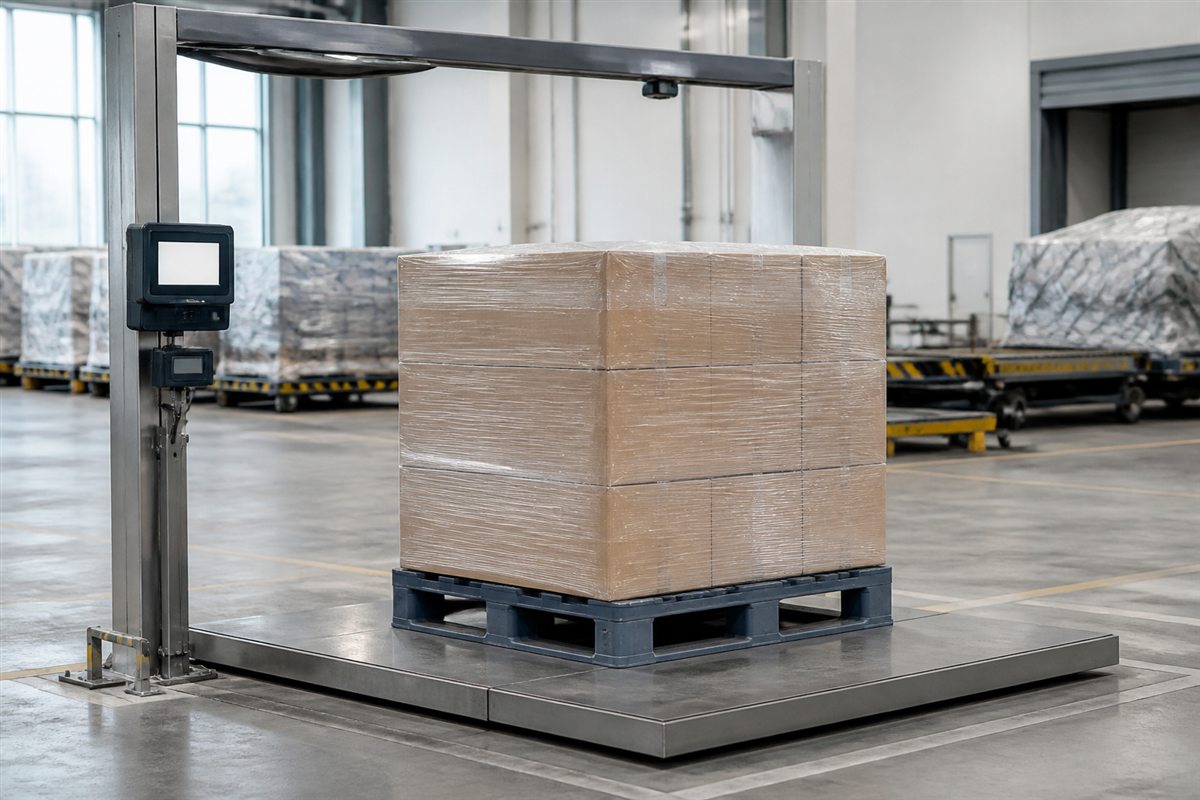
A pallet that is 5 kg lighter does not always remove 5 kg from an air-freight bill. If the shipment is rated by volume, the scale can fall while chargeable weight stays unchanged. If actual gross weight is the controlling number, the same tare reduction may count in full—until the shipment crosses below its volumetric weight.
That crossover is the useful buying test. Compare the finished palletized shipment, not pallet weight in isolation, and obtain both candidate quotes for the same lane, service, date, and cargo. A lightweight pallet only creates a freight saving when it changes the rating outcome without creating a load-support, restraint, fork-entry, or acceptance problem.
Find which number controls the quote
Air cargo commonly distinguishes two weights:
- Actual gross weight is the weighed mass of the complete shipment, including goods, inner and outer packaging, pallet, wrap, straps, edge protection, and other components tendered with it.
- Volumetric weight converts the shipment’s occupied space into a rating weight. IATA’s public explanation gives a general metric rule: multiply the external length, width, and height in centimetres, then divide by 6000.
The higher of actual and volumetric weight is generally used for rating. IATA also makes clear that tariffs and acceptance rules can be carrier-, country-, airport-, and consignment-specific, and that other charges may sit outside the airport-to-airport rate. Treat the 6000 divisor as a planning check, not as a substitute for the forwarder’s or carrier’s current written quote. IATA air-cargo tariffs and rules .
Use this planning calculation:
Planning volumetric weight (kg) = greatest finished length (cm) × greatest finished width (cm) × greatest finished height (cm) ÷ 6000
Then compare it with the finished actual gross weight. Confirm the applicable divisor, piece treatment, rounding, minimum charge, rate breakpoint, special-cargo rule, and surcharges for the real booking.
A worked crossover shows when tare matters
Assume one wrapped unit measures 120 × 100 × 120 cm. Under the IATA planning rule, its volumetric weight is 240 kg.
| Same cargo, different pallet case | Actual gross weight | Planning volumetric weight | Planning chargeable weight | What changed |
|---|---|---|---|---|
| 190 kg cargo and packaging + 15 kg pallet | 205 kg | 240 kg | 240 kg | Volume controls |
| Same load + 10 kg pallet | 200 kg | 240 kg | 240 kg | Tare falls 5 kg, but planning chargeable weight does not |
| 235 kg cargo and packaging + 15 kg pallet | 250 kg | 240 kg | 250 kg | Actual weight controls |
| Same dense load + 10 kg pallet | 245 kg | 240 kg | 245 kg | The 5 kg tare reduction remains chargeable |
There is a third possibility. If a lower-profile approved pallet reduces the finished height from 120 cm to 115 cm while the 120 × 100 cm footprint and cargo stack stay unchanged, planning volumetric weight falls from 240 kg to 230 kg. That saving comes from a measured change in the completed unit’s external cube, not from the label “lightweight.” It only counts if the lower structure still supports, protects, and can be handled with the actual load.
Do the arithmetic before asking suppliers to remove material. A lighter design may be commercially irrelevant in a volume-controlled shipment, while a small reduction in real loaded height may matter more. Conversely, dense cargo may reward every verified kilogram of tare reduction.
Measure the tendered unit, not the drawing
Catalog dimensions are not enough for an air-cargo comparison. Build each candidate with representative goods and the normal packaging process, then record:
- the calibrated scale result for the complete unit;
- the greatest external length, width, and height after wrap, straps, corner boards, labels, and normal bulge;
- the number of pieces and whether the forwarder will rate or consolidate them together;
- any orientation, stacking, screening, special-cargo, or handling restriction;
- the equipment used before tender, at the terminal, and at destination.
A 5 cm pallet-height reduction can disappear if the cartons bulge, an edge protector projects, or the load pattern has to grow taller. A narrow nominal footprint also provides no saving if wrap or overhang sets the measured width. Photograph the finished configuration and keep the dimensions with the quote so procurement is comparing reproducible units.
Give nesting the right job
Nesting is valuable when empty pallets must be stored or returned, but it does not automatically reduce the cube of a loaded outbound shipment. When cartons occupy the deck, the greatest finished dimensions usually control the planning volume.
Ask one route question: Will empty pallets actually travel by air?
- If no empties return, nesting may help origin storage or disposal handling but should not be credited with an air-return saving.
- If empties return by road or sea, calculate that loop separately using its own vehicle, labor, loss, and damage assumptions.
- If empty pallets are repositioned by air, measure the complete nested stack as tendered and request a separate quote. Stack stability, separation effort, damage inspection, and handling acceptance still belong in the trial.
This keeps two valid benefits from being confused: lower tare can affect actual-weight rating, while tighter nesting can affect empty-return cube. The existing nestable-versus-rackable pallet guide can help when return density must be balanced against storage duty.
Do not buy a rate saving that fails the route
Air-freight economics does not approve the pallet. HSE’s pallet guidance links suitability to the load type, weight distribution, transport vehicle or container dimensions, movement equipment, environment, and restraint. It also notes that plastic pallet surfaces can require additional measures to secure goods and that buyer-manufacturer communication is essential. HSE Pallet safety PM15 .
For each lighter candidate, confirm at least:
- the exact support condition and whether the load is uniform or concentrated;
- deck coverage, anti-slip and restraint method, and what happens during tilt or transfer;
- fork and pallet-truck entry on the origin and destination route;
- loaded deflection, damage criteria, and inspection before each use;
- exposure to cold, moisture, impact, screening, and repeated handling;
- the supplier evidence and sample limits tied to the exact model or revision.
Do not transfer a catalog load number from another support method, temperature, or pallet version. If empty manual handling is a material part of the case, use the separate plastic pallet weight and manual-handling RFQ guide rather than treating lower tare as an ergonomic approval.
Run one same-lane A/B decision
The cleanest comparison uses the same goods, packaging pattern, lane, service, and quote date.
Build A and B. Load each candidate pallet with the same representative cargo. Apply the normal wrap, restraint, and labels. Reject a comparison if one unit uses a different carton count or a weaker restraint solely to look smaller.
Weigh and dimension. Record finished actual mass and greatest external dimensions. Calculate planning volumetric weight with the divisor supplied for the quote, then retain the forwarder’s final chargeable-weight result and rounding.
Obtain two written quote lines. Ask for chargeable weight, rate basis or breakpoint, relevant minimum, surcharges, and any acceptance limitation. A lower chargeable weight may not reduce the total if a minimum or different rate band applies.
Move the samples. Use the normal forklift or pallet truck, staging surface, turn, transfer, and destination handoff available for the trial. Inspect load shift, wrap damage, deck or base deformation, fork contact, and pallet damage.
Choose from total evidence. Approve the lighter pallet only when the quote effect is repeatable and the complete handling route passes the responsible teams’ acceptance criteria. Record the cargo, pallet revision, dimensions, mass, restraint, quote assumptions, and changes that trigger a new trial.
Put the comparison into the RFQ
Give suppliers and forwarders the same brief:
- cargo description, piece count, cargo-plus-packaging mass, and load distribution;
- target finished footprint and height, including the allowed overhang or projection;
- candidate pallet mass tolerance and exact structure or revision;
- origin, destination, service, booking unit, and expected shipment frequency;
- forklift, pallet-truck, storage, screening, and destination-handoff conditions;
- restraint method, sample-trial plan, and damage rejection criteria;
- request for finished-unit dimensions, gross mass, applicable rating rule, chargeable weight, and total quoted charges.
Use the plastic pallet category to organize candidate formats after the load and route are defined. For a bounded comparison, share the cargo mass, finished dimensions, handling equipment, lane, and trial conditions . The useful supplier question is not “What is your lightest pallet?” but “Which approved configuration gives the lowest repeatable total cost for this tendered unit?”
The purchase decision should fit on one comparison sheet: finished mass, finished cube, quoted chargeable weight, total quote, handling result, and approval limits. That sheet shows whether lower tare is a real air-freight saving, a benefit for another part of the route, or merely a smaller number in a catalog.