Industry Insights
Nestable vs Rackable Plastic Pallets: How Buyers Should Split the Decision
Use load support, rack exposure, empty-return cost, and handling intensity to decide when nestable or rackable plastic pallets fit your lane.
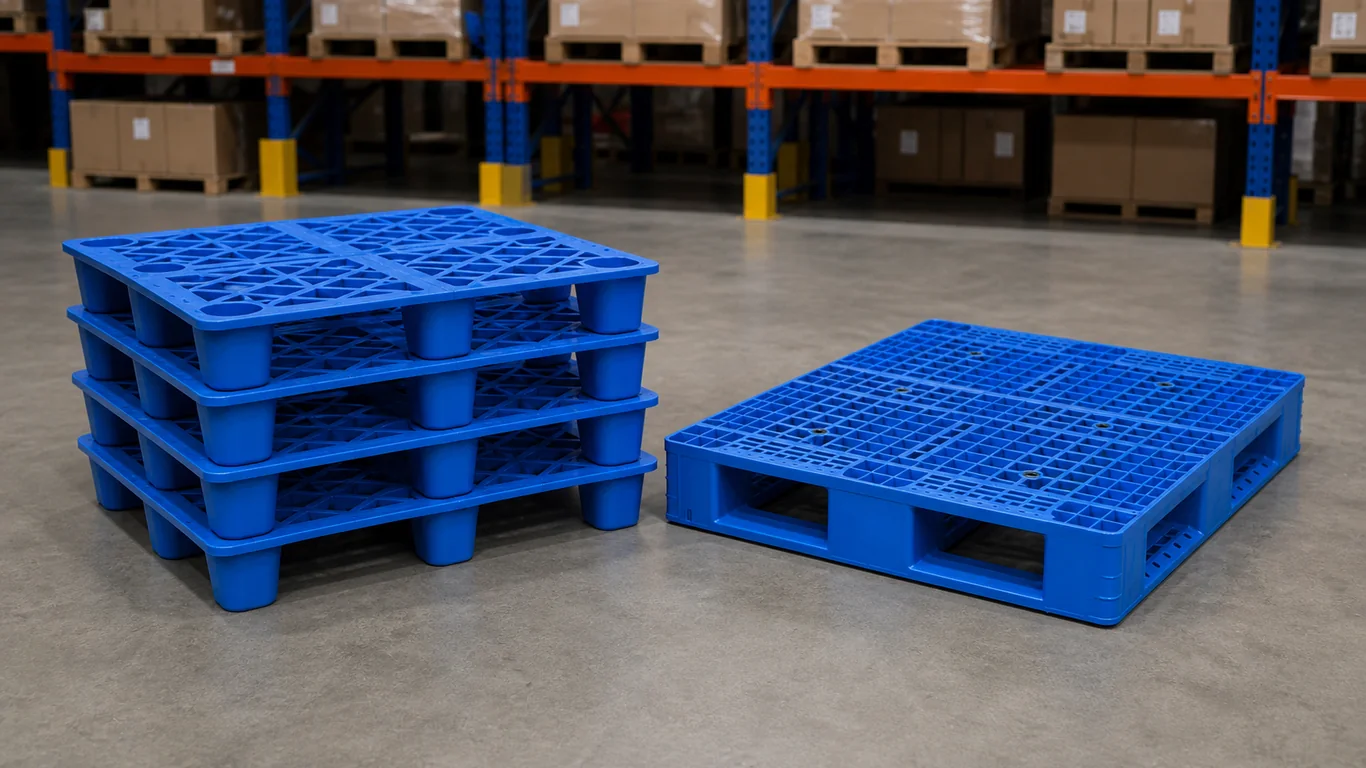
Choose nestable plastic pallets when empty-return cube, one-way export, or light floor handling matters more than beam-rack storage. Choose rackable plastic pallets when the pallet will spend meaningful time on rack beams, carry heavier or less evenly distributed loads, or face frequent forklift handling. If your network includes both export lanes and racked warehouse lanes, a dual-spec pallet program is often safer than forcing one compromise model everywhere.
That answer is only a starting point. Final approval still depends on the exact pallet structure, support method, load distribution, temperature, beam span, and the supplier documents tied to the model you will actually buy. This guide turns those conditions into a practical selection rule, RFQ language, and sample-approval checklist.
Start with the lane, not the catalog category
The same buyer may be comparing pallets for very different jobs:
- export shipments that rarely return;
- closed-loop warehouse circulation;
- selective rack storage on beams;
- floor staging and block stacking;
- short dwell times in dispatch areas;
- long dwell times under load in storage.
If you do not separate those lanes first, “nestable” and “rackable” become marketing labels instead of operating decisions.
What changes between nestable and rackable structures
| Question | Nestable pallets usually fit when | Rackable pallets usually fit when | What still needs confirmation |
|---|---|---|---|
| Empty return volume | Empty pallets must nest tightly to reduce truck or container space | Empty return efficiency matters less than storage strength | Nesting ratio, stack height, and whether damaged pallets still nest safely |
| Rack exposure | Pallets rarely sit on beams or only do so briefly under controlled loads | Pallets regularly sit on rack beams or remain there for meaningful dwell time | Beam span, support direction, load distribution, and deflection limit |
| Handling intensity | One-way or lower-touch routes dominate | Forklifts handle the pallet repeatedly in multi-shift operation | Fork-entry wear, runner damage, and impact points after repeated use |
| Load footprint | Loads are light-to-medium and mostly uniform | Loads are heavier, partially supported, or sometimes point-loaded | Static, dynamic, and racking ratings under comparable test conditions |
| Standardization strategy | One simple export or floor-handling lane is the main priority | Warehouse safety and repeatability across racked lanes matter more | Whether one model really fits every lane without hidden cost |
The useful rule is structural, not ideological. A low-cost nestable pallet can become expensive if it causes rack restrictions, faster replacement, or handling delays. A strong rackable pallet can become wasteful if the route is mostly one-way export and empty-return cube drives the economics.
Use four buyer questions before RFQ release
1. How often will the pallet sit on rack beams?
If beam storage is routine, start from rackable options. A racking claim is not meaningful unless the supplier defines:
- support span between beams;
- support direction and contact width;
- load distribution used during the test;
- dwell time and temperature;
- allowable deflection or other pass/fail condition.
Without those conditions, do not treat “rackable” as proof that the pallet fits your rack.
2. What does the load really look like?
Use operational language, not only one headline weight:
- typical load per pallet;
- maximum regular load;
- whether cartons cover the full deck or leave gaps;
- whether drums, pails, sacks, or machinery create point loads;
- whether the center of gravity shifts in transport.
A pallet that performs well with uniform cartons may behave differently with partial loads, dense bags, or mixed-SKU pallets.
3. Is empty-return freight part of the business case?
For export-heavy or return-intensive networks, cube efficiency can outweigh modest price differences. Compare:
- empty pallets per truck or container;
- labor needed to stack and separate empties;
- risk of nesting damage or jamming;
- whether the customer or depot returns pallets at all.
This is where nestable pallets often win. But empty-return savings should be calculated against the real loop, not assumed.
4. How aggressive is the handling route?
Multi-shift forklift traffic, dock transfers, ramps, and frequent turns create a different damage profile from calm staging areas. Review:
- fork-entry direction and clearance;
- runner or leg wear points;
- pallet jack compatibility if required;
- outdoor staging, washdown, cold-room, or freezer exposure;
- whether the lane includes conveyors, shuttles, or AS/RS contact.
When a dual-spec pallet program is the safer answer
Many teams keep looking for one pallet that can do everything. That is often the wrong optimization.
Use two pallet specifications when:
- export lanes value empty-return density but domestic warehouses use beam racks;
- one network mixes light consumer loads and heavy industrial loads;
- customers receive pallets differently from the origin warehouse;
- hygiene-sensitive zones need one pallet architecture while general circulation uses another.
A two-model program can look more complex in purchasing, but it often reduces field failures and avoids overbuying heavy-duty pallets for light lanes.
RFQ wording buyers should lock in
Before asking suppliers for price, define at least:
- the intended lane: export, closed loop, floor-only, rack storage, or mixed use;
- pallet size, target height, and acceptable tolerance;
- load profile: typical load, peak load, and whether loads are uniform or point-loaded;
- support condition: floor, stack, rack beam span, conveyor, or mixed support;
- handling equipment: forklift, pallet jack, AGV, shuttle, or wrapper contact;
- temperature, outdoor exposure, washdown, or chemical exposure limits;
- required documents: data sheet, material statement, test report, or limitation note;
- sample acceptance method and lot-to-lot consistency requirements.
A practical clause can be simple:
Supplier shall identify whether the quoted pallet is nestable or rackable and confirm the exact bottom structure, intended support method, tested rack condition if applicable, empty-stack behavior, and operating limitations for the buyer’s defined load and handling route. Final approval depends on sample testing under the buyer’s real load and support conditions.
What to inspect during sample approval
Do not approve a pallet because it “looks strong” or because an empty sample nests well.
Check:
- loaded pallet stability under the actual product footprint;
- rack behavior after the planned dwell time if beam storage is used;
- fork-entry damage, runner wear, and corner impact after repeated handling;
- empty-stack height, stack stability, and ease of separating nested pallets;
- pallet jack entry if customers or warehouses rely on pallet jacks;
- dimensional consistency against equipment or rack constraints;
- whether the delivered production lot matches the approved sample and supplier statement.
If the route includes rack storage, connect approval to the racking pallet steel reinforcement checklist and the rack deflection acceptance guide . If the route is still being defined, pair this page with the plastic pallet RFQ specification checklist before quoting.
Practical decision rule
Choose nestable first when the lane is mostly floor handling or one-way/export use, loads are moderate and reasonably uniform, and empty-return logistics materially affect total cost.
Choose rackable first when the pallet regularly sits on beams, loads are heavier or less evenly distributed, or the route relies on repeat forklift handling and dimensional stability.
Choose both when one network includes both export efficiency and rack-storage safety requirements.
The correct answer is not the category name. It is the pallet structure that matches your actual support condition, load behavior, handling route, and supplier-backed limitations.