Buying Guides
Commercial Wheeled Bins: Confirm the Lift Interface Before Buying
Confirm collector acceptance, EN 840 part, lifting interface, filled mass, lid, markings, and a witnessed trial before ordering commercial wheeled bins.
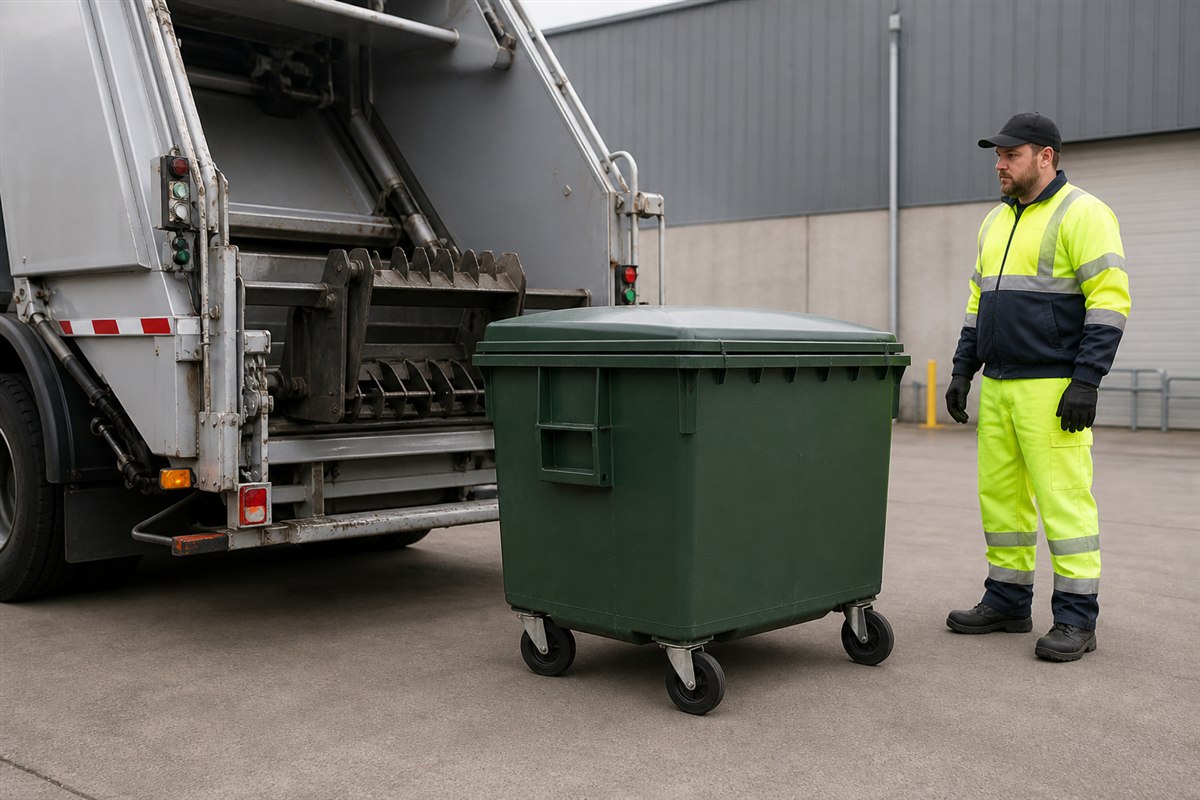
“660 litres” or “1,100 litres” does not tell a collection vehicle how to lift a bin. Two containers with the same nominal capacity can differ in lid form, receiver geometry, overall dimensions, filled mass, markings, and the condition of the points that meet the lifting device. A bin can fit the storage area and still be refused at collection.
The useful purchasing order is therefore collector first, container second. Obtain the collector’s written acceptance requirements for the actual service and vehicle fleet, then ask suppliers to respond against that same document. Do not release a bulk order until the collector or its authorised operator has accepted the exact sample and loading case that will be used.
Start with an acceptance envelope, not a catalogue size
Ask the organisation that will empty the bin to identify the accepted envelope in writing. That may be a local authority, a contracted waste carrier, or an operator using an on-site bin lifter. Record at least:
- the service, waste stream, site, collection point, and vehicle or lifter types that may attend;
- accepted container capacities, external dimensions, material, lid and aperture arrangements, colours, and identification;
- the required lifting interface, such as comb, trunnion, or a stated combination;
- the applicable EN 840 part or local equivalent, together with any contract-specific requirement;
- allowed filled mass or service weight rule, including how an overweight or compacted load is handled;
- wheel, brake, towing, lock, and access requirements that affect movement to the vehicle;
- who owns inspection, repair, rejection, replacement, and damage decisions;
- the sample-trial method and the person authorised to sign acceptance.
If the collector cannot provide this information, the purchase is not ready. A supplier drawing cannot define the collection vehicle, and a service contract cannot prove the dimensions or condition of the bin delivered.
Use the correct standard part, then keep going
BSI describes BS EN 840-2:2020 as covering four-wheel mobile waste and recycling containers up to 1,300 litres with flat lids for trunnion and/or comb lifting devices. Its corresponding BS EN 840-3:2020 page covers dome-lid containers in that capacity range. The distinction matters: “EN 840” without a part, lid form, and lifting configuration is incomplete purchasing language.
The standard reference is still not a universal collection guarantee. BSI’s descriptions tie these container classes to the explicitly named lifting devices and compatible approved lifters. The real service can impose a narrower envelope.
Wandsworth Council provides a clear current example. Its rules for privately purchased containers require, among other points, a steel body, hinged lid, comb lifting suitability, BS EN 840-3:2020 conformity, labelling, and at least 660 litres capacity. A plastic bin of the right nominal size would not satisfy that particular material rule. This is why local acceptance must precede a product shortlist, not follow delivery. Wandsworth container requirements .
Keep three mass statements separate
Nominal volume answers how much space the container is intended to provide. It does not define the density of the waste or the mass presented to the lifter.
The container supplier may state a nominal load or another capacity under defined conditions. The collection service may set a different operational weight limit based on its vehicle, route, waste stream, charging method, and safety controls. The actual filled mass can differ again, especially with wet, dense, compacted, or wrongly segregated material.
Put all three in the acceptance sheet:
| Statement | Evidence owner | Purchasing use |
|---|---|---|
| Container volume and supplier load statement | Supplier, tied to the exact model and revision | Defines what the product documentation actually covers |
| Collector’s accepted service weight | Collector or vehicle operator | Defines what the service will present to its lifting system |
| Representative filled mass at the site | Buyer or site operator, using an agreed measurement method | Tests whether the real waste stream stays inside both boundaries |
Do not convert litres to kilograms with one generic factor. Sample the real waste stream over representative and peak periods. If compaction, rainwater, liquids, glass, food waste, or process scrap can change mass, treat that as a separate loading case and obtain the collector’s decision.
Match the physical interface and its condition
Compare the collector’s requirement with the exact production drawing and sample, not a family brochure. Record the front receiver or comb bar, trunnions where applicable, lid clearance, wheel positions, brake arrangement, handles, overall width and depth, and any feature that can collide with or obstruct the lifter. Confirm that required labels or apertures do not interfere with engagement and remain usable on the collection route.
Condition is part of compatibility. HSE explains that hoists fitted to refuse collection vehicles are lifting equipment and that safety-critical attachment points need suitable maintenance; it also advises looking for visible defects before use. HSE transport-related lifting operations . For a wheeled-bin programme, turn that principle into named rejection criteria for cracked or distorted receivers, damaged trunnions, failed wheels or brakes, lid interference, and unauthorised repairs. Record which decisions belong to the collector, equipment manufacturer, bin supplier, and site team.
Run a witnessed interface trial before volume purchase
The trial belongs under the collector’s or authorised equipment operator’s control. Agree the sequence and stop conditions before the sample reaches the vehicle.
- Identify the sample. Record model, revision, drawing, lid, wheels, brakes, lifting features, empty mass documentation, and photos without relying on colour alone.
- Inspect the approach. Move the bin along the real storage-to-collection route and check slopes, thresholds, turns, parked vehicles, doors, and the position required at the lifter.
- Check empty engagement. The authorised operator confirms alignment, capture, clearance, locking, release, and return using the applicable instructions. Stop if anyone must force, strike, modify, or improvise the interface.
- Repeat with an agreed representative load. Record filled mass, waste type, distribution, lid closure, wheel and brake behaviour, and the operator’s observations. Do not create an overload to “prove” capacity.
- Test permitted variation. If more than one vehicle, lifter, lid, waste stream, or load case is part of the contract, include it or exclude it explicitly from approval.
- Sign the boundary. State what passed, who accepted it, what remains excluded, and which changes require a new trial.
A successful empty lift does not approve an unknown filled mass. One vehicle does not approve every vehicle in a contractor’s fleet. A demonstration bin does not approve later production if the interface or revision changes.
Make the purchase order enforce the accepted sample
Attach the acceptance sheet to the RFQ and purchase order. Require suppliers to identify the exact model and revision, the standard and part claimed, the lifting configuration, dimensions and tolerances that matter to engagement, documented load conditions, markings, inspection guidance, and change-notification process. Define how incoming units will be checked against the accepted sample and what happens when a unit is damaged or outside the agreed envelope.
Keep collection-day people and access controls in a separate operating check. The existing commercial wheeled-bin collection-day safety guide covers secure siting, unusual contents, visibility, and escalation before collection; it does not approve the lifting interface.
Only compare the site’s plastic waste-bin category after the collector has confirmed that plastic is acceptable for the service. For a bounded product discussion, send the written collector requirements, interface, sample load case, route, and acceptance method . A supplier can then answer against a defined job instead of guessing from litre capacity.
Release the order only when the contract, vehicle interface, exact container, real route, and representative filled condition agree. A signed acceptance envelope gives receiving staff something they can check; a litre label or a general compatibility claim does not.