Industry Insights
Fresh Produce Crates: Match Ventilation to the Precooling Route
Choose reusable plastic produce crates by proving airflow, drainage, crop protection, and cooling performance in the actual filled and stacked route.
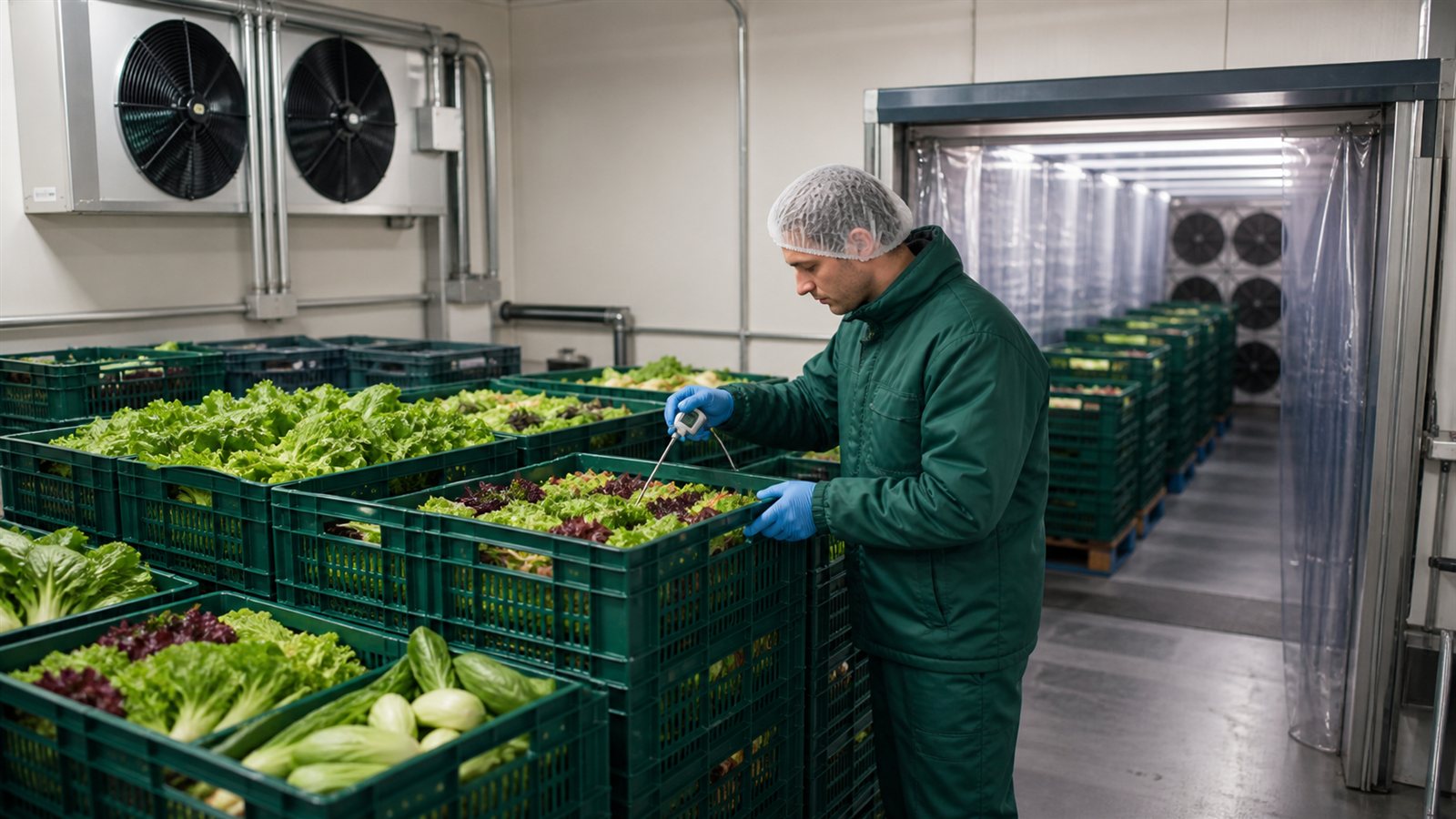
Choose the cooling route before choosing the crate. A crate described as “ventilated” may still cool unevenly when produce blocks its openings, liners interrupt the air path, or stacked vents do not align. The useful buying question is not “How many holes does it have?” but “Can this filled crate, in this stack and this cooler, bring this crop to the operation’s target without unacceptable dehydration, water retention, bruising, or delay?”
That answer has to be demonstrated with the real crop and route. Crate selection cannot set a crop’s safe temperature, cooling time, humidity, or sanitation process; those limits belong with the operation’s postharvest, food-safety, and refrigeration specialists.
Start with the cooling route
The same crate geometry can behave differently under room cooling, forced-air cooling, hydrocooling, and refrigerated transport. Use the route to decide what must be checked.
| Route | What moves heat | What the crate must let you verify | Common buying trap |
|---|---|---|---|
| Room cooling | Cold room air circulates around stacks and gradually through the load | Exposed surfaces, space between stacks, vent alignment, filled depth, and enough time for the warmest produce to reach the target | Assuming the room setpoint means the centre of every crate is cool |
| Forced-air cooling | A pressure difference pulls or pushes cold air through packages and produce | A continuous inlet-to-outlet path, aligned vents, controlled bypass air, limited blockage from produce or liners, and representative pulp-temperature checks | Comparing empty-crate open area while ignoring the filled and palletized airflow path |
| Hydrocooling | Chilled water contacts produce and carries away heat | Water-compatible crate and crop, vertical water access, drainage, retained-water points, wet handling strength, and the site’s water-safety controls | Treating side ventilation as proof that water reaches and drains from the whole load |
| Refrigerated holding or transport | Refrigeration removes ongoing heat and maintains an already established cold chain | Air circulation around the load, stable stacking, vent alignment after restraint, and temperature maintenance through handoffs | Expecting a vehicle or storage room to remove field heat that the precooling step did not remove |
FAO packing-house guidance explains that forced-air cooling depends on a pressure difference across ventilated container stacks. It also notes that vents must be positioned and aligned so they are not blocked, and that liners or dividers can slow cooling. Its room-cooling guidance likewise requires exposed container surfaces and air movement between stacks. FAO packing-house guidance .
USDA guidance makes the broader boundary clear: precooling success depends on the produce, shipping container, starting and final temperatures, cooling medium, and continuity after cooling. Packaging used with air cooling must release heat; packaging used with hydrocooling must tolerate direct water contact. USDA Agricultural Export Transportation Handbook .
Vent area is not a performance result
A percentage on a drawing can be useful, but it does not show the effective path through a working load. Review at least these five interfaces:
- Crate to crate. Side and end openings should still line up in the approved stack orientation. A reversed stack-and-nest crate or an offset mixed stack can close the intended path.
- Crate to produce. Leaves, bags, cushioning, paper, or an overfilled top layer can sit directly against vents. A nominal opening that is covered in use contributes little airflow.
- Outside to centre. Cooling air or water follows the easiest route. Large gaps outside the crates can allow bypass while the centre of the produce mass remains warm.
- Cooling to moisture control. Faster air movement can improve heat removal but also increase water loss, especially for crops with high surface area. A liner may reduce dehydration yet extend cooling time by restricting airflow. Neither choice is automatically correct.
- Cooling to protection. More or larger openings can affect contact protection and package strength. Smooth internal surfaces, suitable filled depth, drainage, stacking stability, and handling still matter.
FAO’s reusable-crate guide describes ventilated plastic crates as useful for airflow during cooling, refrigerated transport, and cold storage, while also treating smooth surfaces, handling, stacking, cleaning, and system management as connected requirements. FAO reusable plastic crate guide . FAO postharvest guidance also warns that airflow is necessary to remove heat but can accelerate moisture loss, so crate and stacking design should provide controlled rather than simply maximum airflow. FAO guidance on airflow and water loss .
Run a loaded cooling trial before a volume order
An empty sample and a supplier drawing are not enough. Use a representative trial that the responsible operations team can repeat.
1. Freeze the test configuration
Record the crop and variety, maturity or condition, harvest and holding history, starting temperature range, fill mass or count, fill depth, liner or pad, crate orientation, stack pattern, unit-load arrangement, cooling equipment, and target defined by the responsible postharvest owner. If any of these changes, the earlier result may not transfer.
2. Inspect the physical interfaces
Confirm that produce is not crushed by the crate above, rough or sharp features do not contact the crop, handholds remain usable, vents are not covered, and the loaded stack is stable. For a wet route, inspect drainage points and any pockets that could retain water.
3. Place temperature checks where failure is likely
Do not measure only cold room air or the easiest outside crate. Measure representative produce in expected warm locations: for example, near the centre of a filled crate, in a middle stack position, and at the end of the airflow path. Use the operation’s approved instruments and method.
4. Run the actual cycle
Use the normal stack length, tarp or plenum arrangement, fan setting, water route, loading delay, and operating sequence. Observe whether air or water bypasses the produce, whether liners shift, and whether drainage is complete enough for the next handling step.
5. Check temperature uniformity and time
Compare the warmest representative points with the target and allowed time set by the specialist. A quick reading at one surface does not establish that the load is uniformly cooled.
6. Inspect quality and handling after cooling
Look for wilting, shrivelling, chilling or freezing injury, bruising, compression, trapped water, damaged packaging, unstable stacks, and difficult manual handling. The absence of a temperature failure does not erase a product-quality or worker-handling failure.
7. Repeat and define acceptance
One favourable run may reflect unusually cool harvest conditions or a light fill. Repeat across the operating range that matters, document the accepted crate-and-pack configuration, and name the changes that require retrial.
USDA ARS guidance shows why the loaded test matters: forced-air cooling time changes with airflow, produce dimensions, and internal packaging, while hydrocooling packages must permit water flow and tolerate wetting. USDA ARS commercial storage handbook .
Put the route into the RFQ
Give competing suppliers the same operating brief. Ask each one to identify evidence and limits rather than replying with a generic “food crate” recommendation.
| Information to provide | Response to request |
|---|---|
| Crop, variety or product group, and damage sensitivity | Proposed crate geometry and the assumptions behind it |
| Cooling method and equipment interface | Intended airflow or water path through a filled, stacked load |
| Starting condition, target set by your specialist, and allowed cycle | Trial method and measurement locations to verify the target |
| Fill mass or count, depth, liner, pads, and pack pattern | Usable internal dimensions, contact surfaces, vent locations, and liner interaction |
| Stack orientation, height, pallet or floor pattern, and restraint | Stacking interface, alignment controls, and handling limits under the stated conditions |
| Wetting, washing, drainage, and protected-storage route | Material and care documentation relevant to the stated process, without treating it as food-safety validation |
| Return, inspection, cleaning, and rejection process | Identification and damage-rejection information for the reusable loop |
If the return-to-use decision is also in scope, use the separate reusable produce-crate release check . Cooling performance and hygiene release are related controls, but one does not prove the other.
Make the purchase decision from the route evidence
The most useful comparison is a short record: the defined crop and route, the filled crate configuration, the representative temperature results, the quality and handling observations, and the conditions under which the result remains valid. This turns “ventilated” from a catalog adjective into an operating requirement.
You can use the plastic crates and boxes category to organize the formats you want to compare. When you are ready to request a bounded comparison, share the crop, cooling method, fill, liner, stack, and trial requirements rather than asking for ventilation in isolation.
This guide is a procurement framework, not a universal postharvest specification. Confirm commodity temperatures, humidity, cooling time, water treatment, food-contact and sanitation controls, worker safety, and local requirements with the responsible specialists before approval.