Industry Insights
Plastic Pallet Fire Safety in Warehouses: Storage Checks Before Bulk Purchase
A practical guide for procurement, warehouse, and EHS teams on reviewing plastic pallet fire safety, empty pallet storage, sprinkler limits, and RFQ requirements before scaling a pallet program.
Plastic pallet fire safety is often reviewed too late. A pallet may be the right size, strong enough for the load, compatible with forklifts, and economical in return logistics, yet still create approval problems if the warehouse fire-protection design does not match how the pallets will be stored.
The issue is not simply that a pallet is plastic. The practical question is how the pallet material, design, quantity, storage height, commodity, packaging, sprinkler system, aisle layout, and local fire rules interact in the actual building. A small closed-loop pallet pool may be easy to manage. A high stack of empty pallets near a dock, a rack system with plastic pallets under mixed goods, or a new export program that changes pallet volume can require a formal review before rollout.
The useful purchasing question is:
What should buyers check before ordering plastic pallets at scale so the warehouse can store, handle, and document them without creating fire-protection or insurance problems?
Start with the building, not the pallet catalog
Plastic pallets should be reviewed against the warehouse fire-protection design. That includes the sprinkler system, ceiling height, rack type, stored commodity, packaging, aisle width, smoke or heat detection, and the site’s emergency access rules.
Do not assume that a pallet accepted in one warehouse is automatically acceptable in another. The same pallet may be used differently across sites:
- floor-stacked under finished goods;
- stored in selective racking;
- nested as empty pallets near loading docks;
- staged in a production area between shifts;
- shipped to customer warehouses with unknown protection systems;
- used with cartons, bags, drums, trays, or plastic crates.
Each condition changes the risk review. Before bulk purchase, ask the warehouse, EHS, insurer, and fire-protection professional whether the planned use fits the current system. The NFPA 13 standard page is a useful reference point because sprinkler protection is normally evaluated by storage arrangement and hazard, not by pallet price or pallet category alone.
Separate loaded pallet storage from empty pallet storage
Loaded pallets and empty pallets are not the same fire-safety question.
A loaded pallet is part of a commodity package: pallet, product, cartons, film, containers, and storage arrangement. The fire-protection review considers the full unit load and how it is stored.
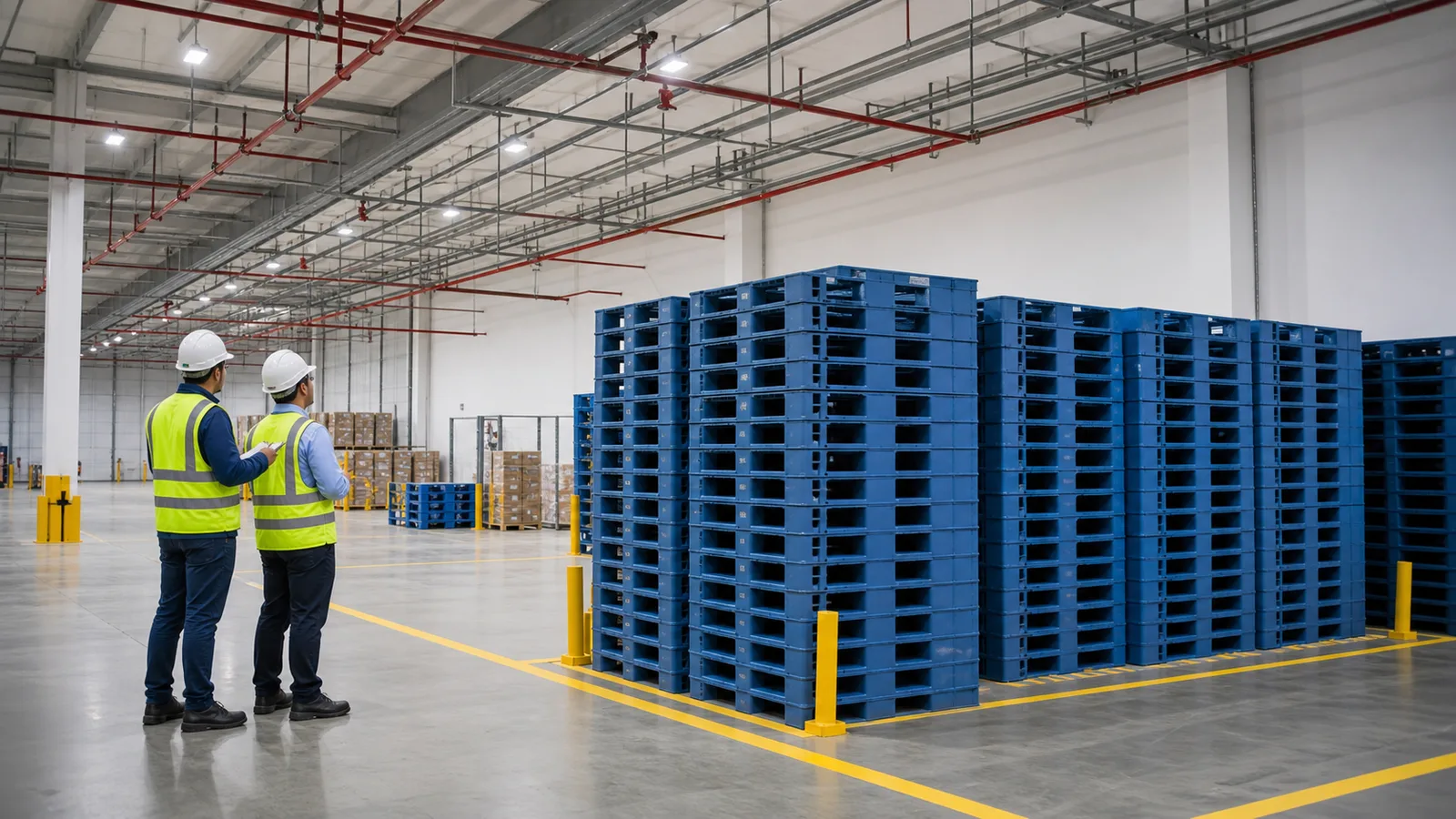
Empty plastic pallets create a different problem because the pallet material is concentrated in one place. Nestable pallets can save valuable return-space volume, but the same nesting efficiency can also create a tall, dense empty-pallet pile if the site does not set limits. Stackable or rackable pallets may create more open spaces, but the quantity and height still matter.
For this reason, the empty-pallet rule should be written separately from the loaded-pallet rule. Define:
- maximum empty stack height;
- maximum number of pallets per stack;
- whether stacks may be stored indoors;
- whether empty pallets require a dedicated area;
- minimum separation from docks, chargers, packaging waste, and production lines;
- whether outdoor storage is allowed and under what housekeeping rules;
- who releases overflow storage during peak season.
If a site is already planning stack limits for operational reasons, add the fire-safety review to the same exercise. The plastic pallet stack height planning guide covers floor capacity, handling, and access checks that can be extended with sprinkler clearance and empty-pallet limits.
Confirm sprinkler clearance and storage height before layout changes
Storage height is not only a stability concern. It also affects whether water can reach the fire area as intended.
Before changing pallet type or increasing pallet inventory, confirm:
- ceiling height and sprinkler type;
- minimum clearance required below sprinklers;
- permitted rack height and floor-stack height;
- whether pallets are stored under mezzanines or low beams;
- whether seasonal overflow blocks sprinkler discharge patterns;
- whether in-rack sprinklers, flue spaces, or rack layout assumptions must be maintained.
Operational teams sometimes create fire-protection problems unintentionally. A new pallet program may reduce empty return trips, so more pallets remain on site. A temporary promotion may push pallets into aisles or under dock canopies. A change from wood to plastic may be approved for one product family but then copied to another area with a different storage method.
For racked goods, pallet strength and fire protection should be reviewed together. Rack suitability is not only about whether the pallet can carry the load. It also depends on beam span, load distribution, rack layout, and maintained clearances. The rack deflection acceptance guide can help procurement teams define the mechanical test while EHS confirms the storage protection rules.
Treat plastic pallets as part of the commodity classification discussion
In many warehouses, the product and packaging decide the fire-protection basis. A plastic pallet can change that discussion, especially when the load includes plastic containers, plastic film, foam, aerosols, flammable liquids, rubber goods, or other higher-risk materials.
Ask for the stored commodity description in practical terms, not only product names:
- product material and packaging material;
- carton type, inner packaging, and stretch film;
- pallet material and design;
- gross pallet load and storage height;
- whether goods are solid, porous, liquid, aerosol, or mixed;
- whether products are stored in racks, on the floor, or in bulk blocks;
- whether empty pallets are stored in the same fire area.
This information helps the fire-protection professional or insurer evaluate the storage condition correctly. It also prevents a common purchasing gap: the pallet is approved by logistics, but the safety review later asks for details that were never included in the RFQ.
When goods involve chemicals, spill risk, or combustible liquids, the pallet decision should be reviewed with containment and hazardous-material procedures as well. The chemical and spill-control handling page is a useful starting point for operational questions, but fire classification and code compliance still need project-specific confirmation.
Control ignition sources around pallet storage
A plastic pallet policy should also cover where pallets may be staged. Fire risk increases when pallet piles are close to ignition sources or poor housekeeping areas.
Review whether empty or loaded pallets are stored near:
- battery charging areas;
- shrink-wrap tunnels or heat sealing equipment;
- welding, maintenance, or hot-work zones;
- compactors, waste cardboard, or film scrap;
- electrical panels, temporary wiring, or chargers;
- dock doors where debris accumulates;
- outdoor areas exposed to vehicles, smoking, or unauthorized access.
Basic storage discipline matters. OSHA’s material-handling storage rule, 29 CFR 1910.176 , addresses secure storage and clearance for aisles and passageways. For pallet programs, that principle should be translated into visible floor markings, clear no-storage zones, and supervisors who can stop overflow stacking before it becomes normal practice.
This is not only an EHS task. Procurement can help by specifying pallet return frequency, maximum on-site inventory, and packaging flow so the warehouse is not forced to store more empty pallets than the fire plan allows.
Check whether pallet design changes the storage behavior
Different plastic pallet structures lead to different storage habits.
Nestable pallets reduce empty volume, which can be a major advantage for export and return logistics. The tradeoff is that empty stacks can grow quickly because nesting makes tall piles look compact. Buyers should define stack limits and return cycles before increasing pool size.
Rackable runner pallets may be needed for loaded storage on beams, but they often take more space when empty. That can push warehouses to place empties in side aisles or dock corners unless a dedicated area is planned.
Closed-deck pallets can support hygiene and spill-control needs, but cleaning and drying areas may create temporary pallet accumulation. If wet pallets are held near production, chargers, or packaging waste, the staging rule should be clear.
Pallets with rubber inserts or anti-slip features may improve load control, but the site should confirm whether inserts affect cleaning, inspection, maintenance, and fire review. The feature may be useful, but it should not be treated as a purely mechanical detail.
The right design is the one that supports the operating route and can still be stored within the site’s approved fire-protection limits.
Include fire-safety questions in the sample approval
Most pallet sample trials focus on load capacity, fork entry, racking, impact, cleaning, and unit-load stability. Add a short fire-safety documentation review before sample approval becomes a bulk purchase.
Ask these questions:
- Where will loaded pallets be stored, and at what maximum height?
- Where will empty pallets be stored between use cycles?
- What is the maximum number of empty pallets allowed indoors?
- Does the sprinkler system support the proposed storage condition?
- Does the insurer or local authority require review before rollout?
- Are aisle, exit, sprinkler, panel, and fire-equipment clearances protected?
- Are seasonal overflow rules written down?
- Are pallet return and washing cycles frequent enough to avoid excess accumulation?
- Are receiving sites or customers subject to different rules?
This review does not replace code analysis. It makes sure procurement does not approve a pallet that later fails at the building, insurance, or customer receiving stage.
Write fire-safety assumptions into the RFQ
A useful RFQ does not need to ask the pallet supplier to certify the buyer’s warehouse fire system. That responsibility belongs to the building owner, insurer, fire-protection engineer, and local authority. The RFQ should still capture the facts needed for review.
Include:
- pallet material and whether recycled content is proposed;
- pallet type: nestable, rackable, double-faced, closed deck, or specialty;
- loaded and empty storage method;
- expected maximum on-site pallet quantity;
- expected empty-pallet stack height;
- whether pallets will be stored indoors, outdoors, or both;
- product and packaging type used with the pallet;
- rack or floor-storage method;
- sample documents, drawings, and material information needed by EHS;
- requirement to avoid unsupported claims about fire approval or code compliance.
A practical clause may read:
Supplier shall provide pallet material, design description, dimensions, nesting or stacking behavior, and storage recommendations for buyer review. Fire-protection suitability will be confirmed by the buyer’s EHS team, insurer, fire-protection professional, and applicable local authority before bulk rollout. Supplier shall not represent the pallet as universally approved for all warehouse fire-protection conditions.
This wording keeps responsibilities clear. The supplier provides accurate product information. The buyer confirms whether that product fits the actual building and storage plan.
Set operating controls after approval
Approval should not end with the purchase order. Warehouse conditions change.
After rollout, maintain:
- marked empty-pallet storage areas;
- maximum stack-height signs;
- routine checks for aisle and sprinkler clearance;
- return or wash cycles that prevent pallet overflow;
- rules for damaged pallets and packaging waste;
- periodic review after layout changes, new products, or seasonal peaks;
- a process for EHS approval before pallets are moved into new zones.
If the pallet program expands, repeat the review. Adding a second product family, a new customer loop, or a temporary overflow area may change the fire-protection condition even when the pallet model stays the same.
Practical decision rule
Do not approve a plastic pallet program on mechanical performance alone.
Approve the pallet when the load test, handling trial, storage layout, empty-pallet rule, sprinkler clearance, housekeeping controls, and EHS review all point to the same operating plan.
Choose nestable pallets when return-space efficiency matters, but control empty-stack height and quantity.
Choose rackable structures when beam storage is required, but confirm racking layout and fire-protection assumptions together.
Use the supplier’s pallet data as input, not as a substitute for building-specific fire review. The safest pallet specification is the one that can be purchased, handled, stored, inspected, and defended under the real warehouse conditions where it will be used.