Buying Guides
Plastic Pallets for Pallet Inverters: What to Specify
Specify the plastic pallet, completed load, clamp contact, and replacement-pallet interface together before a pallet-inverter trial.
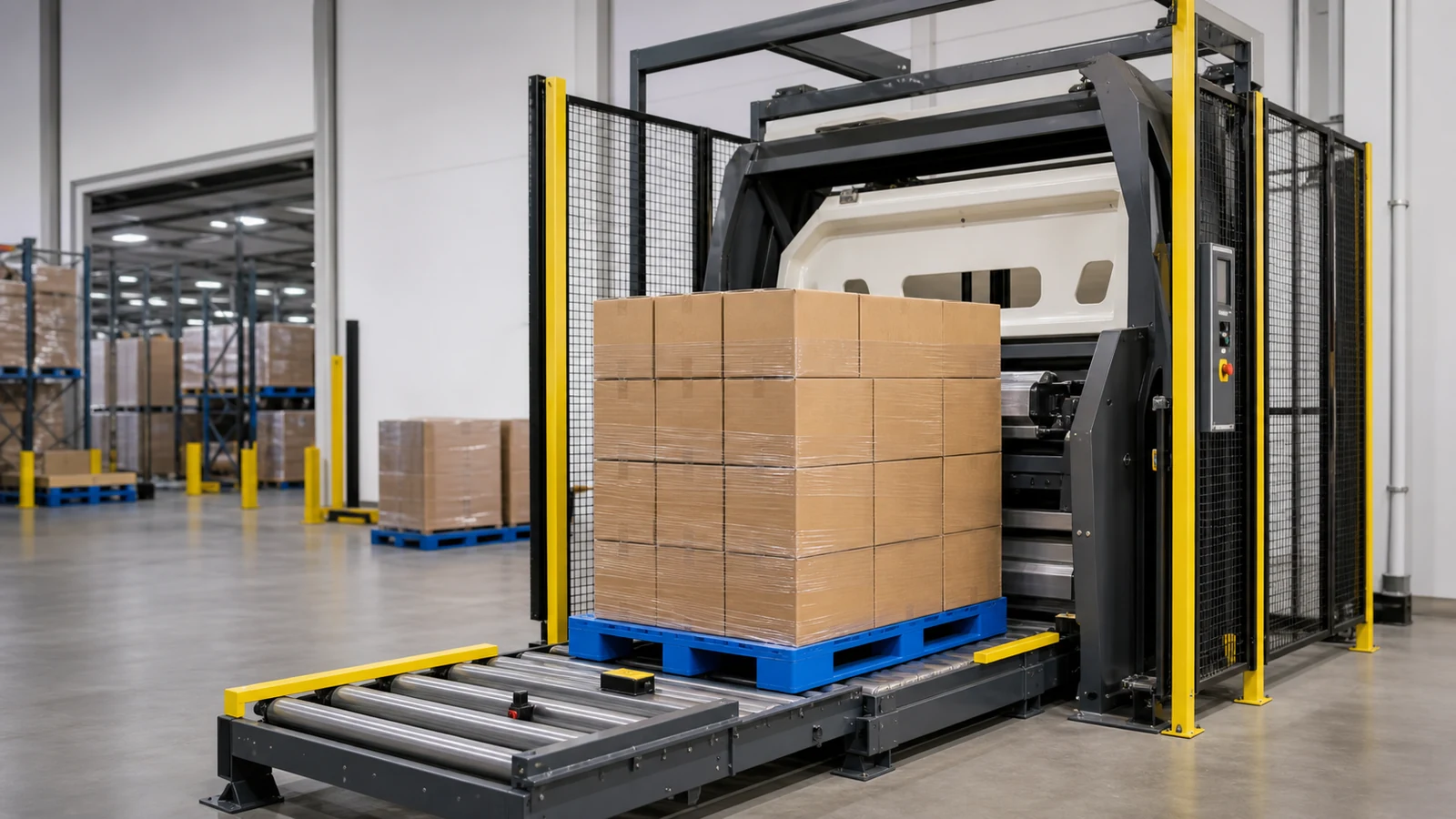
A plastic pallet is suitable for a pallet inverter only when the completed load, clamp contact, machine envelope, and replacement pallet work together. A pallet that travels safely by forklift can still be the wrong interface for an inverter. Do not order against the phrase “inverter compatible.” Give the equipment owner and supplier the actual load envelope, pallet orientation, contact surfaces, and the job the inverter must perform, then trial the real combination.
Pallet inverters are used for jobs such as changing a damaged or non-approved pallet, removing spacers, or transferring a load to a different pallet. The machine does not test only the incoming pallet: it clamps and rotates a whole unit load, and the pallet chosen after the rotation becomes part of the new support condition. Original equipment documentation illustrates the limit. A Cherry’s inline inverter identifies plastic pallets as a supported type but also gives its own jaw-opening, loading-height, capacity, pallet-gripper, and pressure details. A Samzon PalTurn manual describes changing to a plastic pallet within a stated machine capacity, height, platform, and pallet-size range. Those documents support model-specific interface checks, not a universal approval for plastic pallets.
Start with the combined unit, not the pallet alone
Send this description before comparing pallet models:
| Required input | Why it changes the choice |
|---|---|
| Loaded footprint, height, mass, and centre of gravity | The machine’s opening, capacity, and clamp arrangement apply to the completed unit load |
| Product and packaging surface at the clamp faces | A clamp may touch cartons, bags, trays, or protective boards rather than the pallet |
| Incoming pallet geometry and orientation | Fork entry, base shape, deck openings, runners, and overhang can affect loading, support, and withdrawal |
| Replacement pallet geometry and top deck | After rotation, the new pallet must support the real product footprint without creating a new stability or damage problem |
| Required operation | A one-time damaged-pallet change, spacer removal, and repeated automated transfer can have different equipment and guarding needs |
This is a specification method, not a claim that any one dimension makes a load safe. A pallet size or a forklift rating does not establish that the completed load can be clamped and inverted.
Ask the equipment owner four focused questions
- What are the approved minimum and maximum opening, height, mass, centre-of-gravity, and pallet-size conditions for this exact inverter and configuration?
- Where does the machine contact the unit during loading, clamping, rotation, and discharge, and which load surfaces need protection or a different pressure setting?
- Which incoming and replacement pallet features can interfere with rollers, grippers, sidewalls, platforms, conveyors, or pallet-truck entry?
- Which trial, guarding, operating instruction, energy-control procedure, and operator training must be complete before normal use?
The fourth question matters because the interface decision is not only mechanical. OSHA records have cited pallet-inverter guarding and energy-isolation failures; those enforcement records are not a design standard for every site, but they are a clear reason to keep machine safeguarding and lockout decisions with the responsible employer and equipment owner. See OSHA’s pallet-inverter guarding citation .
Use a loaded trial to separate fit from assumption
ISO 8611-1:2025 states that specific pallet tests do not replace field tests on specific pallet designs. Its published scope is pallet test methods, not inverter acceptance, but the boundary is useful here: a pallet test report cannot prove a combined machine-and-load interface. ISO 8611-1:2025 is the reference for that limitation.
For the intended model and load, have the responsible site team observe a controlled trial that covers the normal orientation and the most demanding approved condition. Record the pallet model and revision, load description, dimensions, mass, product overhang, contact points, machine settings allowed by its owner, transfer path, visible damage or movement, and the decision owner. Stop and recheck when the load, packaging, pallet design, replacement pallet, machine settings, or route changes.
Keep two decisions separate
The pallet decision asks whether the replacement pallet supports the actual product footprint and remains compatible with the required route after transfer. The machine decision asks whether the inverter, safeguards, settings, operating procedure, and people can handle that combined unit. Neither owner should infer the other decision from a product brochure or an unloaded demonstration.
Use this guide alongside the existing load-footprint checks and conveyor bottom-contact guide . Those pages address deck support and conveyor travel. This page adds the separate pallet-change decision: specify and trial the clamped, rotating unit and the new support surface together.
Before routine use, the equipment owner, site safety owner, pallet supplier, and load owner must confirm the actual machine documentation, guard and energy-control requirements, load condition, permitted settings, replacement-pallet support, and local requirements.