Buying Guides
Pallet Shuttle Systems: Choose the Pallet Interface Before You Buy
Choose a plastic pallet for a pallet-shuttle lane from the exact shuttle model, handling direction, lower interface, and completed unit load.
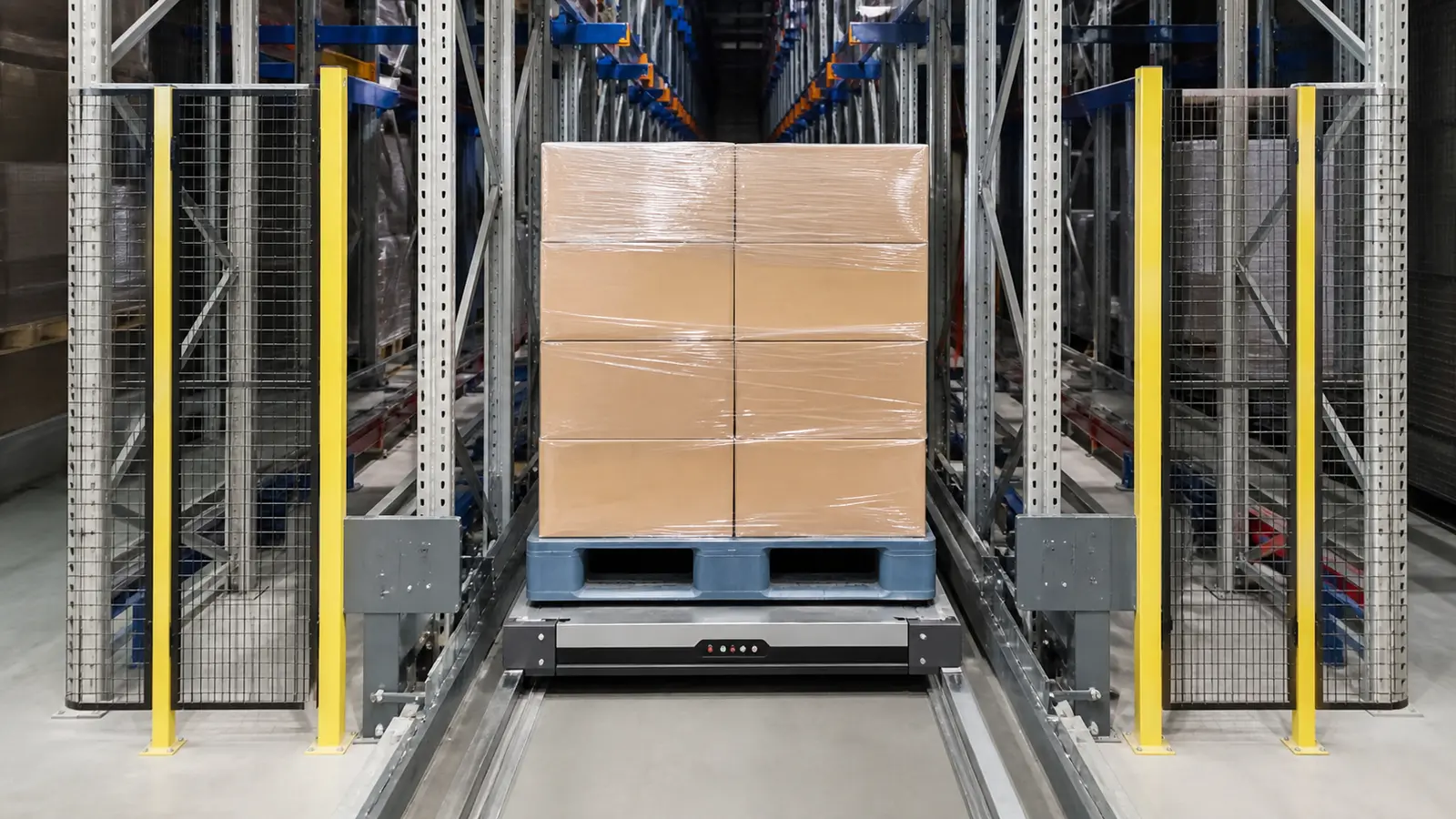
A plastic pallet is not suitable for a pallet-shuttle system merely because it has a familiar footprint or works in ordinary racking. Choose it from the exact shuttle model, the direction in which that model carries the pallet, the lower contact interface, and the completed unit load. That gives the buyer a usable selection brief before quotations or trials begin.
This is a machine-interface selection task. A pallet may be acceptable for forks, floor storage, or even selective racking but still be the wrong carrier for a shuttle lane. The equipment owner decides its approved pallet envelope; the pallet supplier describes the actual model; the site team confirms the loaded combination.
Start with the shuttle’s handling direction
Do not begin with a catalog pallet size. Begin with the machine documentation for the installed or planned shuttle system.
For example, Mecalux describes three automated Pallet Shuttle sizes for common pallet dimensions. In that system, pallets are handled from their 1,200 mm side and the depth varies with 800 mm, 1,000 mm, or 1,200 mm pallet depths. That is useful evidence of a model-specific input, not a universal rule for every shuttle system. Mecalux’s automated Pallet Shuttle description is the source for those stated configurations.
Ask the equipment owner for the current drawing or approved data for:
| Interface input | Why it changes the pallet choice |
|---|---|
| Exact shuttle and rack model | Different systems can have different permissible dimensions, support points, sensors, and entry requirements. |
| Required handling direction | The side that enters first determines which pallet dimension is presented to the machine. |
| Allowed overall length, width, height, and mass | The completed unit load, not an empty pallet, must fit the stated envelope. |
| Lower contact and lift points | Runners, feet, bottom boards, and deformation can change how the machine receives and carries the load. |
| Unit-load footprint and overhang | Cartons, bags, trays, wrap, and corner protection can change clearance and stability. |
ISO 6780:2003 covers principal pallet dimensions and tolerances and includes handling-related features such as openings, clearances, chamfers, and wings. It remains current after ISO’s 2026 confirmation. Its scope helps buyers describe a pallet interface accurately; it does not approve a pallet for a particular shuttle, rack, load, or operating condition. See ISO 6780:2003 .
Decide whether the load needs a direct pallet or a slave pallet
An irregular carrier should not be assumed to travel directly through a shuttle lane. Mecalux states that an irregular pallet, half pallet, or non-palletised load must be mounted on a standard pallet compatible with its shuttle and racking; that standard pallet acts as a slave pallet. This is a useful selection fork:
- Direct compatible pallet: select a pallet whose actual dimensions and lower interface match the equipment owner’s stated envelope for the intended loaded route.
- Slave pallet arrangement: keep the irregular carrier or load on an approved standard carrier, then specify the contact, retention, load height, and transfer method between them.
Neither path is a shortcut to approval. A slave pallet adds another support surface and another interface that the responsible site and equipment owner must assess.
Put the interface in the RFQ, not in a late trial note
Use a separate machine-interface block in the pallet RFQ. Do not rely on phrases such as “shuttle compatible” or “suitable for automated storage.”
| RFQ field | What to state |
|---|---|
| Equipment reference | Exact shuttle, rack, conveyor handover point, and drawing or data revision supplied by the equipment owner |
| Travel orientation | Which pallet side enters first, and whether a rotated orientation is allowed |
| Pallet geometry | Overall dimensions, height, entry openings, runner or foot layout, underside contact areas, and permitted deformation limit if the owner supplies one |
| Completed load | Maximum mass, footprint, height, centre-of-gravity conditions if available, overhang, wrapping, and any dunnage |
| Evidence requested | Current model drawing, stated use limits, sample identity, and the supplier’s confirmation of which requested fields its evidence covers |
| Acceptance owner | The person or team that can approve the real machine, rack, controls, loaded sample, and operating method |
This block prevents an avoidable comparison error: a supplier can confirm a pallet’s model dimensions without claiming that the buyer’s actual shuttle lane, rack rail, controls, or loaded unit has been approved.
Trial the loaded route that will actually run
Before routine use, conduct a controlled site trial with the intended pallet model and normal completed load. The trial should use the agreed direction and include the entry handover, shuttle travel, storage or retrieval where applicable, and the next transfer point. Record the pallet model and revision, loaded dimensions and mass, load condition, orientation, equipment data revision, observed contact or clearance issues, and the decision owner.
Stop and recheck when the pallet design, load footprint, wrapping, rack lane, shuttle model, controls, permitted settings, or transfer equipment changes. A clean empty demonstration cannot prove every loaded condition.
Keep the selection decision separate from machine approval
This guide adds an earlier buying decision to the site’s existing conveyor and racking checks: choose the carrier from the shuttle’s stated interface before a sample is ordered. It does not establish a machine approval, a rack capacity, an automation safety release, or a universal pallet dimension.
Before purchasing or routine operation, the equipment owner and responsible site team need to confirm the current documentation, actual pallet model, completed load, shuttle and rack configuration, permitted operating method, controls, and local requirements. The pallet supplier must confirm only the model-specific information it can substantiate.