Industry Insights
Plastic Pallet Pallet Jack Compatibility: How to Avoid Fork-Entry, Wheel, and Bottom-Deck Problems
A practical guide for warehouse and procurement teams on checking whether plastic pallets work safely with manual pallet jacks, electric pallet trucks, and real loaded handling routes.
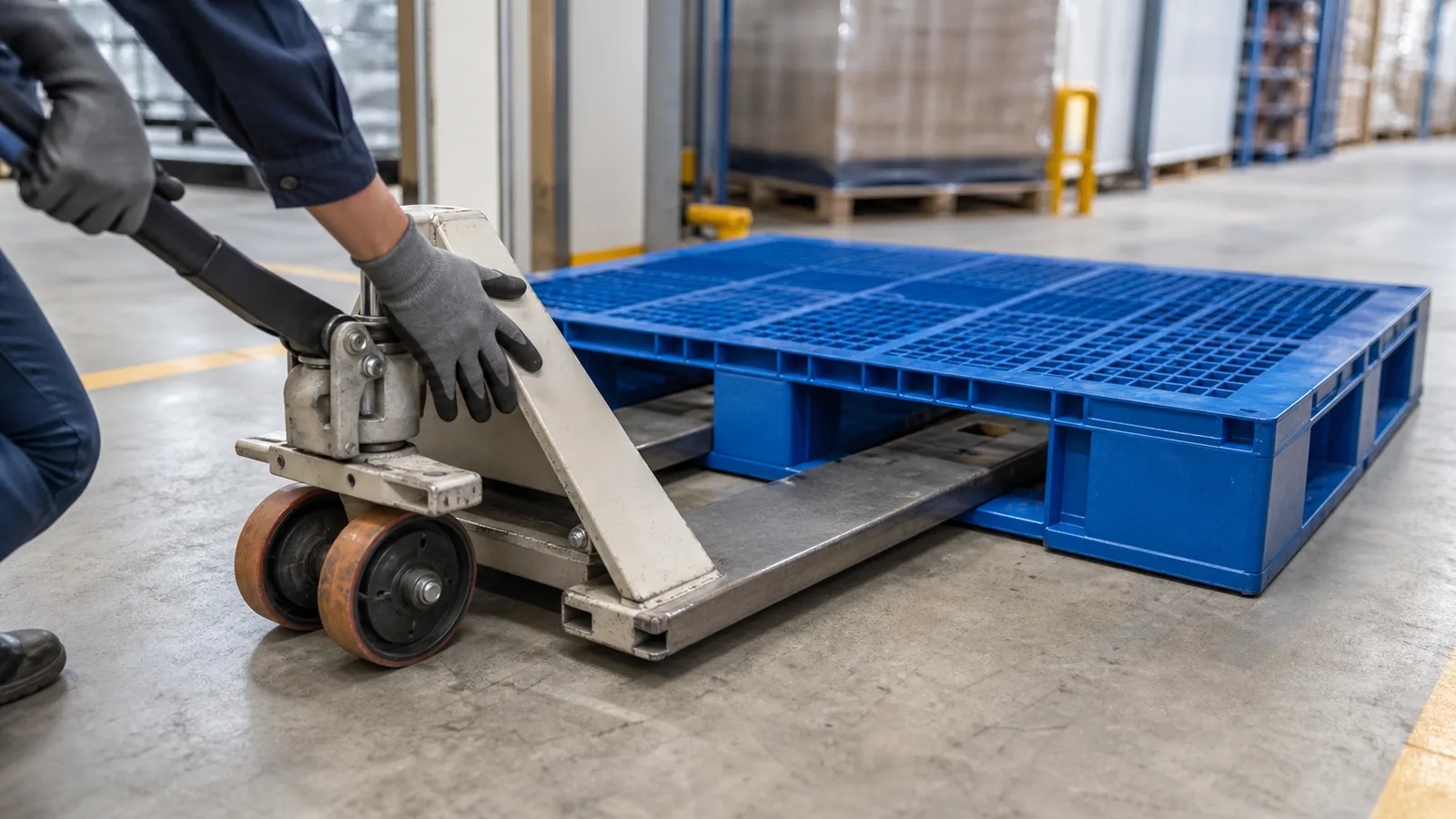
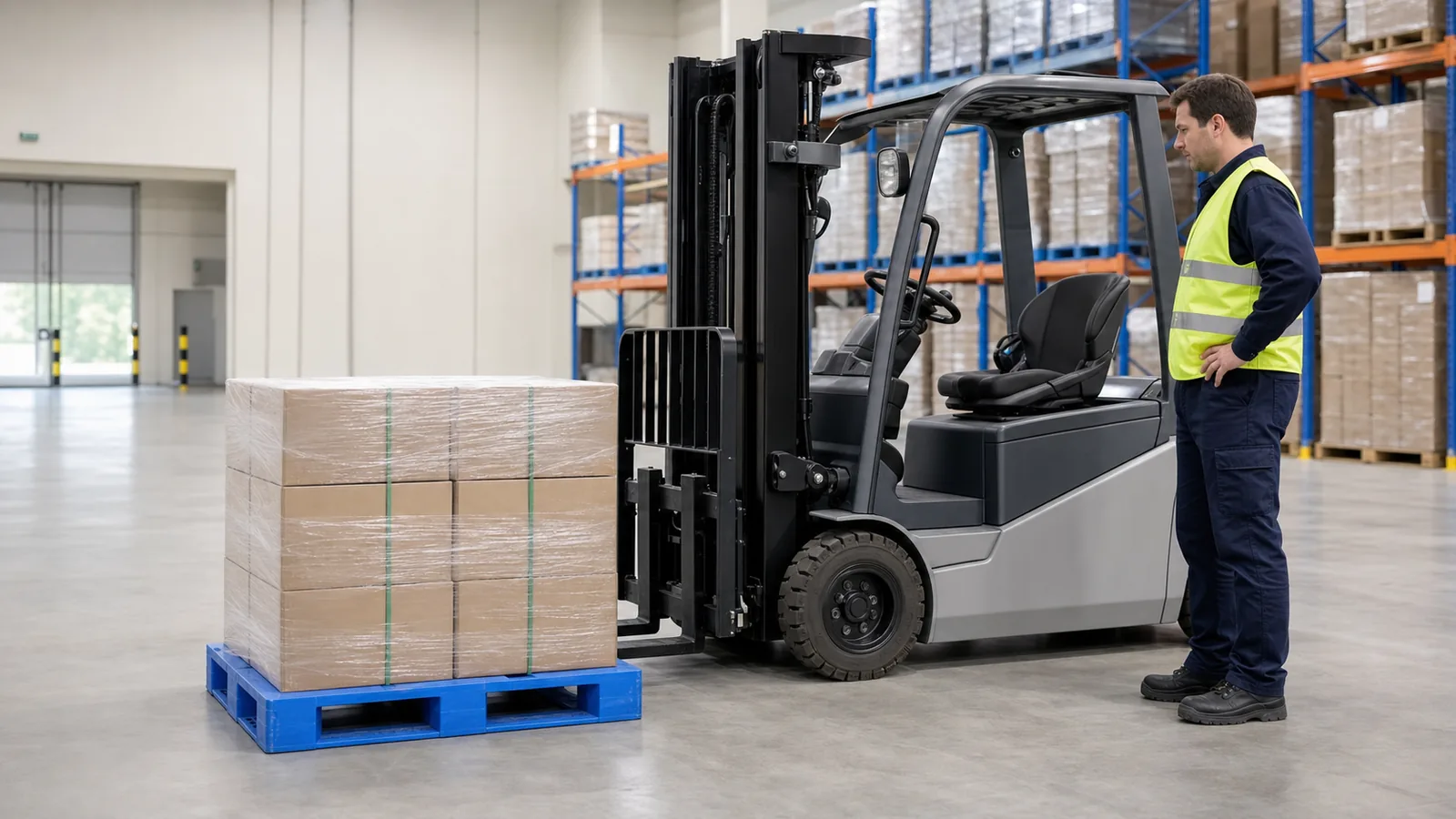
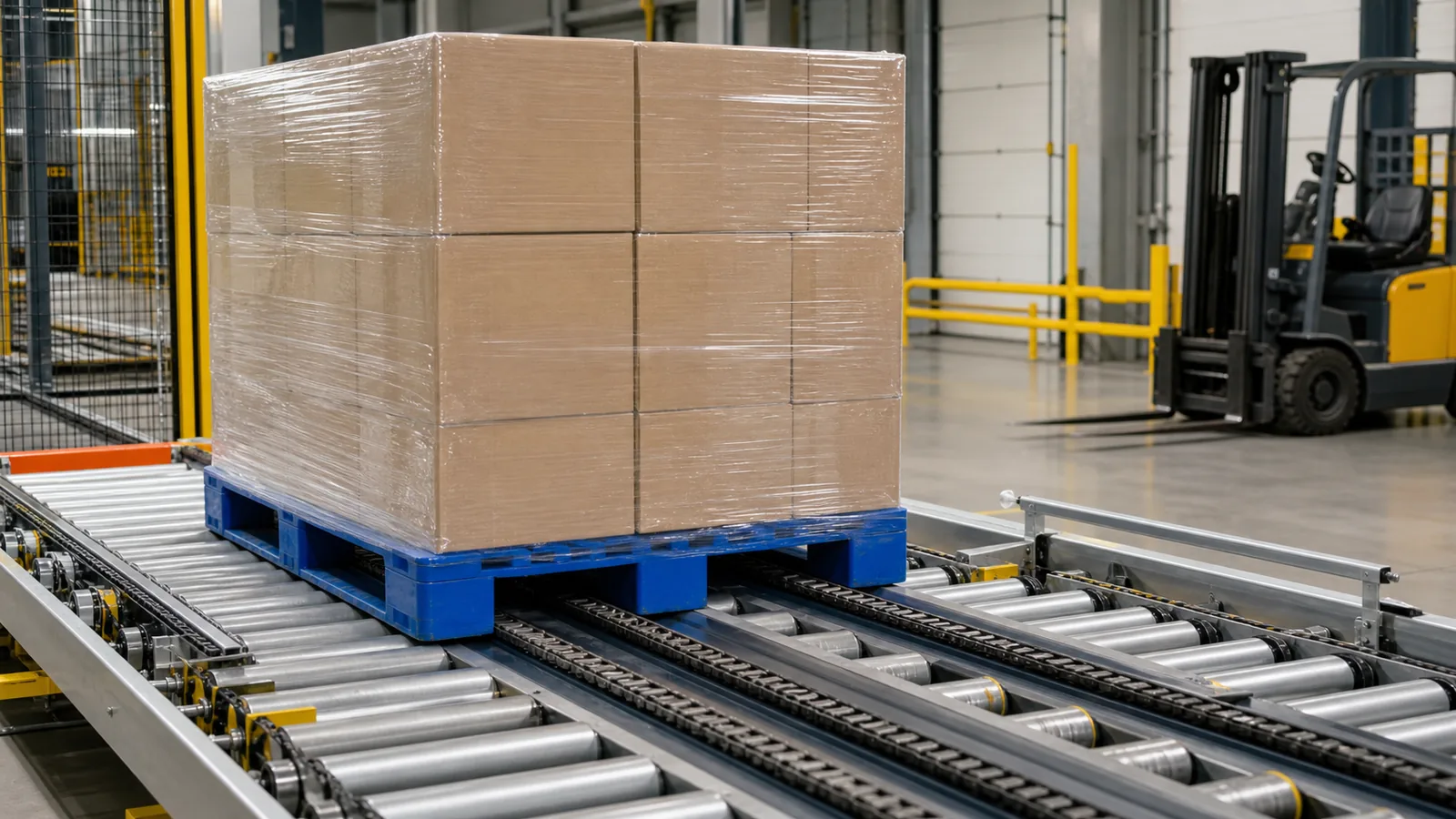
A plastic pallet can have four-way forklift entry and still be awkward, slow, or unsafe with a pallet jack. The difference is easy to miss in purchasing discussions because both pieces of equipment lift from below. In operation, however, a forklift carries the pallet on raised tines, while a manual pallet jack or electric pallet truck must roll its load wheels through the pallet base before it can lift.
That wheel movement changes the compatibility question. Fork opening width is not enough. Buyers also need to check entry height, bottom-deck shape, leg spacing, runner ramps, load-wheel position, floor condition, turning route, and whether the pallet remains usable when loaded.
The practical question is:
How should warehouse and procurement teams specify plastic pallets so pallet jacks can enter, lift, turn, and release the load without damage or daily handling delays?
Do not treat forklift entry as pallet jack approval
“Four-way entry” usually means a forklift can approach the pallet from four sides. That does not automatically mean a pallet jack can work from four sides.
A forklift tine can enter a relatively simple pocket and lift vertically. A pallet jack needs a continuous path for its forks and load wheels. During entry, the wheel assembly may contact the pallet’s center legs, runner bridge, underside ribs, or entry lip. During lifting, the pallet base must clear the floor without rocking, scraping, or trapping the load wheels.
Common symptoms of poor pallet jack compatibility include:
- operators hitting center legs during entry;
- pallet jacks stopping halfway under the pallet;
- bottom runners scraping when the jack is raised;
- loads tilting because one wheel path is blocked;
- workers needing to approach only from one side despite a four-way claim;
- damaged entry lips, cracked legs, or broken underside ribs;
- extra time spent repositioning pallets in staging lanes.
These issues rarely appear on a product photo. They appear when the selected pallet, loaded product, pallet jack model, and warehouse floor are used together.
Identify the pallet jack type before choosing the pallet
Not all pallet jacks interact with pallets in the same way. Before approving a pallet, record the equipment that will actually handle it.
| Equipment input | What to confirm | Why it matters |
|---|---|---|
| Manual pallet jack | fork width, fork length, lowered height, raised height | determines whether the jack can enter and lift without scraping |
| Electric pallet truck | load-wheel position, battery body clearance, turning radius | affects entry from tight aisles and dock staging areas |
| Straddle stacker | outrigger spacing and pallet access side | may require a different pallet bottom structure |
| Ride-on pallet truck | wheel path and approach space | higher speed and weight can increase entry damage |
| Destination equipment | customer’s pallet jack or receiving equipment | export shipments may be handled by equipment the shipper does not control |
For multi-site networks, do not assume that one pallet jack model represents all locations. Older manual jacks, low-profile jacks, electric walkies, and rental equipment can have different fork heights and load-wheel geometry.
If the pallet will be used only by forklifts at origin but by pallet jacks at retail, distributor, or customer receiving points, the receiving equipment matters just as much as the shipper’s equipment.
Check entry height under real load
Entry height is one of the most common causes of pallet jack problems. A pallet may accept a jack when empty but become difficult after loading because the deck deflects, the base settles, or the load wheels need more clearance than expected.
Check three conditions:
- Empty pallet entry: the jack should enter without forcing, angling, or catching on the entry lip.
- Loaded pallet entry: the jack should enter after the pallet has been loaded with the heaviest normal product.
- Post-use entry: the jack should still enter after the pallet has gone through normal handling, stacking, or transport.
The third condition is often missed. Plastic pallets can develop local wear at fork-entry zones. If the pallet is frequently dragged, side-loaded, or hit at the entry lip, clearance can become worse over time.
For inbound receiving, add pallet jack entry to the regular release inspection. The incoming inspection plan for plastic pallets can be expanded with fork opening height, blocked wheel path, and underside runner checks before a new lot enters circulation.
Follow the load-wheel path, not only the fork pocket
The load wheels are the parts most likely to expose a mismatch. When a pallet jack enters a pallet, its front wheels roll ahead of the fork tips. If those wheels meet a vertical leg, high cross rib, sharp transition, or unsupported gap, the jack can stop or climb unevenly.
Inspect the pallet underside from the jack’s point of view:
- Is there a clear wheel path from entry to final lifting position?
- Are center legs shaped or spaced to allow wheel travel?
- Do runners have lead-in ramps, chamfers, or smooth transitions?
- Can the wheels pass under the load without dropping into a molded recess?
- Does the pallet sit flat enough that both forks lift evenly?
- Does the jack release cleanly when lowered?
This check is especially important for pallets with a perimeter base, double-faced deck, or reinforced underside. These structures can improve strength or stack stability, but they may also reduce pallet jack access if the jack is not matched to the base design.
Match pallet structure to the handling route
Different plastic pallet structures solve different problems. Pallet jack compatibility should be considered together with storage mode, load weight, and return logistics.
Nine-leg nestable pallets are often easier to move with pallet jacks because the base has open access zones and the pallet can save space when empty. A model such as the 1210 open deck 9-leg plastic pallet can be reviewed when the route is light-to-medium load handling, export movement, or floor-only staging. The final choice still needs a loaded jack trial because leg spacing and product weight affect daily handling.
Three-runner pallets can suit forklift flows, rack-supported storage, and some pallet-jack handling when the entry direction and runner profile are compatible. If pallet jacks must approach from multiple sides, confirm whether all intended directions are usable under load.
Perimeter-base and double-faced pallets may provide stronger support for stacking or heavy-duty handling, but some designs are not friendly to standard pallet jacks. They may require forklift-only handling, special low-profile jacks, or a restricted access direction.
The broader decision between nesting efficiency and rack-capable structure is covered in the nestable vs rackable plastic pallet framework . For pallet jack compatibility, the same principle applies: choose the structure for the route, not just the category name.
Consider floor condition, ramps, and dock transitions
A pallet jack has small wheels. Floor conditions that are acceptable for a forklift can become difficult for a pallet jack.
Review the route for:
- dock plates and trailer thresholds;
- floor expansion joints;
- drain channels and washdown slopes;
- freezer-room door transitions;
- rough concrete near loading docks;
- tight turns in staging areas;
- ramps between production and warehouse zones.
Small floor changes can cause a loaded pallet jack to push force into the pallet base. If the bottom runner or center leg catches on a threshold, operators may pull harder, twist the jack, or strike the pallet repeatedly. Over time, this can damage the same underside areas that are needed for stable handling.
For routes with ramps or rough dock areas, test with the real gross load. An empty pallet rolling smoothly through the route does not prove that a loaded pallet jack will behave safely.
Test with the actual product footprint
Pallet jack compatibility is not only about the pallet and equipment. The load changes how the pallet behaves.
A uniform carton load may keep the deck level and leave fork entry clear. Drums, pails, machinery parts, bagged goods, or partial loads may create localized deflection that narrows the clearance under the pallet. Stretch wrap tension can also pull a load out of square and make the pallet harder to enter from one side.
Before bulk approval, test at least these load cases:
- the heaviest normal pallet load;
- the smallest product footprint that creates concentrated pressure;
- the tallest load that affects operator visibility;
- the most common mixed-SKU pallet;
- any load that will be staged on dock plates or ramps.
If the pallet is also being evaluated for strength, combine the jack trial with a broader plastic pallet load testing plan before bulk orders . This avoids approving a pallet that passes static or racking checks but slows every pallet-jack movement.
Define access direction clearly
Some pallets can be lifted by pallet jack from two sides but not four. That may be acceptable if the warehouse layout controls orientation. It becomes a problem when pallets rotate during receiving, wrapping, staging, or outbound loading.
Write the access rule in operational language:
- pallet jack entry allowed from long side only;
- pallet jack entry allowed from all four sides under load;
- forklift required for short-side handling;
- no pallet jack use after double stacking;
- customer receiving must have forklift or compatible electric pallet truck.
If the pallet travels to customers, distributors, or third-party warehouses, mark the handling limit in documentation. A shipper may control its own warehouse, but it may not control the receiving dock. Compatibility failures often become customer complaints because the load arrives on a pallet that the receiver cannot move with available equipment.
Build a short pallet jack trial before purchase
A practical test can be completed in one shift if the team prepares the right inputs.
Use this sequence:
- Measure the pallet jack fork width, fork length, lowered height, and raised height.
- Measure pallet entry height, fork opening width, and wheel-path clearance.
- Enter the empty pallet from every required direction.
- Load the pallet with the heaviest normal product.
- Enter, lift, turn, move, lower, and release the pallet on the actual route.
- Repeat after wrapping, staging, and truck or dock transfer if those steps are routine.
- Inspect the pallet underside for rubbing, whitening, cracks, or blocked wheel paths.
- Ask operators to record any forced angle, extra pull, or side-only workaround.
The test should include the equipment used by the receiving team if that differs from the origin warehouse. When that is not possible, request equipment dimensions from the receiver and compare them with the pallet’s access geometry.
Write pallet jack requirements into the RFQ
Vague RFQ wording such as “suitable for pallet jack” leaves too much to assumption. A better RFQ describes the equipment and pass/fail condition.
Include:
- pallet jack type and model, if known;
- fork width, fork length, lowered height, and raised height;
- required entry directions;
- maximum gross pallet load;
- load type and product footprint;
- floor route, dock plate, ramp, or threshold conditions;
- whether pallet jack use is required at customer receiving;
- sample trial method and acceptance criteria;
- any direction restrictions that must be molded, marked, or documented.
A practical clause may read:
Pallet must be compatible with the buyer’s standard manual pallet jack under a maximum 800 kg gross load. The jack must enter from the two long sides, lift without bottom-deck scraping, travel through the defined staging route, and release cleanly after lowering. Samples must be tested with the buyer’s actual product footprint before bulk approval.
This level of detail helps suppliers recommend a suitable base structure instead of assuming that forklift entry and pallet jack entry mean the same thing.
Acceptance criteria for daily handling
Before approving the sample, define what “works with pallet jacks” means in observable terms.
Useful criteria include:
- jack enters from all required directions without impact or forcing;
- load wheels follow a clear path under the pallet;
- pallet lifts level enough for safe travel;
- bottom deck or runners do not scrape during normal movement;
- pallet does not rock, twist, or trap the jack when lowered;
- operators do not need unplanned turning or reorientation;
- no visible cracking, whitening, or deformation appears at entry zones;
- handling time is acceptable for the lane;
- receiving teams can move the pallet with their available equipment.
If a pallet fails, identify the exact failure point before changing the specification. The correction may be a different pallet base, a restricted entry direction, a lower-profile jack, a revised load pattern, or a route change at the dock.
Practical decision rule
Approve pallet jack compatibility only after the pallet, jack, load, and route have been checked together.
Choose a more open base when pallet jacks are used frequently, loads are moderate, and empty return efficiency matters.
Choose a stronger runner or perimeter structure when storage strength is more important, but confirm whether pallet jack use should be restricted by direction or equipment type.
Do not rely on “four-way entry” as a shortcut. A plastic pallet that works well in a forklift warehouse may still create daily friction if a manual pallet jack cannot roll through its underside cleanly. The best specification is the one that defines how the pallet will actually be moved from loading to receiving.